MCQMediumJEE 2026Carboxylic Acids

JEE Chemistry 2026 Question with Solution

Given below are two statements :

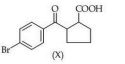
Statement I : Compound (X)(X), shown below, dissolves in NaHCO3NaHCO_3 solution and has two chiral carbon atoms.

Structure of compound X showing a brominated cyclohexene ring attached to a side chain and a cyclobutane carboxylic acid group.

Statement II : Compound (Y)(Y), shown below, has two carbons with sp3sp^3 hybridization, one carbon with sp2sp^2 and one carbon with spsp hybridization.

Structure of compound Y showing a chain with an aldehyde group and a carbon-carbon double bond arrangement for hybridization analysis.

In the light of the above statements, choose the correct answer from the options given below :

  • A

    Statement I is false but Statement II is true

  • B

    Both Statement I and Statement II are false

  • C

    Both Statement I and Statement II are true

  • D

    Statement I is true but Statement II is false

Answer

Correct answer:D

Step-by-step solution

Standard Method

Given: Two statements about compounds (X)(X) and (Y)(Y) are to be checked.

Find: Which statement is true and which is false.

For Statement I, solubility in NaHCO3NaHCO_3 indicates the presence of an acidic group such as COOH-COOH. The given compound contains a carboxylic acid group, so it reacts with sodium bicarbonate and dissolves.

The structure also has two chiral carbon atoms. As stated in the solution, the fragment CH(OH)CH(CH3)COOH-C^*H(OH)C^*H(CH_3)COOH has two starred carbons, and each is attached to four different groups. Therefore, Statement I is true.

For Statement II, analyze the hybridization in CH3CH2CCC(=O)HCH_3-CH_2-C \equiv C-C(=O)H.

  • The CH3CH_3 and CH2CH_2 carbons are sp3sp^3 hybridized. Count =2= 2.
  • The carbonyl carbon C=OC=O is sp2sp^2 hybridized. Count =1= 1.
  • The two carbons in the triple bond CCC \equiv C are both spsp hybridized. Count =2= 2.

So the statement claiming only one carbon is spsp hybridized is incorrect. Therefore, Statement II is false.

Hence, Statement I is true but Statement II is false. The correct option is D.

Concept-Based Check

Given:

  • Solubility in NaHCO3NaHCO_3 is mentioned for compound (X)(X).
  • Hybridization counts are mentioned for compound (Y)(Y).

Find: Evaluate both statements.

Concept 1: Compounds that dissolve in NaHCO3NaHCO_3 generally contain a sufficiently acidic proton, especially the carboxylic acid group COOH-COOH, which reacts to release CO2CO_2.

Concept 2: A chiral carbon must be bonded to four different substituents.

Concept 3:

  • Tetrahedral carbon sp3\rightarrow sp^3
  • Trigonal planar carbon sp2\rightarrow sp^2
  • Linear carbon in triple bond sp\rightarrow sp

Applying these:

  1. Compound (X)(X) contains a carboxylic acid group, so dissolution in NaHCO3NaHCO_3 is justified.
  2. The indicated two starred carbons each have four different groups attached, so there are two chiral centers.
  3. Thus, Statement I is true.
  4. In compound (Y)(Y), the two saturated carbons CH3CH_3 and CH2CH_2 are sp3sp^3.
  5. The aldehyde carbonyl carbon is sp2sp^2.
  6. The alkyne unit contains two spsp carbons, not one.
  7. Thus, Statement II is false.

Therefore, the correct option is D.

Common mistakes

  • Mistake: Assuming any oxygen-containing compound dissolves in NaHCO3NaHCO_3. Why it is wrong: solubility here specifically indicates an acidic group such as COOH-COOH, not merely the presence of oxygen. What to do instead: check whether the compound can react with NaHCO3NaHCO_3 to release CO2CO_2.

  • Mistake: Counting an alkyne as having only one spsp carbon. Why it is wrong: in CC-C \equiv C-, both carbons of the triple bond are spsp hybridized. What to do instead: assign hybridization to each carbon individually.

  • Mistake: Declaring a carbon chiral without verifying all four substituents are different. Why it is wrong: a tetrahedral carbon is chiral only when all attached groups are distinct. What to do instead: inspect each attached group before counting a stereocenter.

Practice more Carboxylic Acids questions

Get unlimited AI-adaptive practice, mastery tracking, and an AI tutor that explains every step — free to start.

Related questions