MCQEasyJEE 2025Carboxylic Acids

JEE Chemistry 2025 Question with Solution

The compounds that produce CO2CO_2 with aqueous NaHCO3NaHCO_3 solution are:

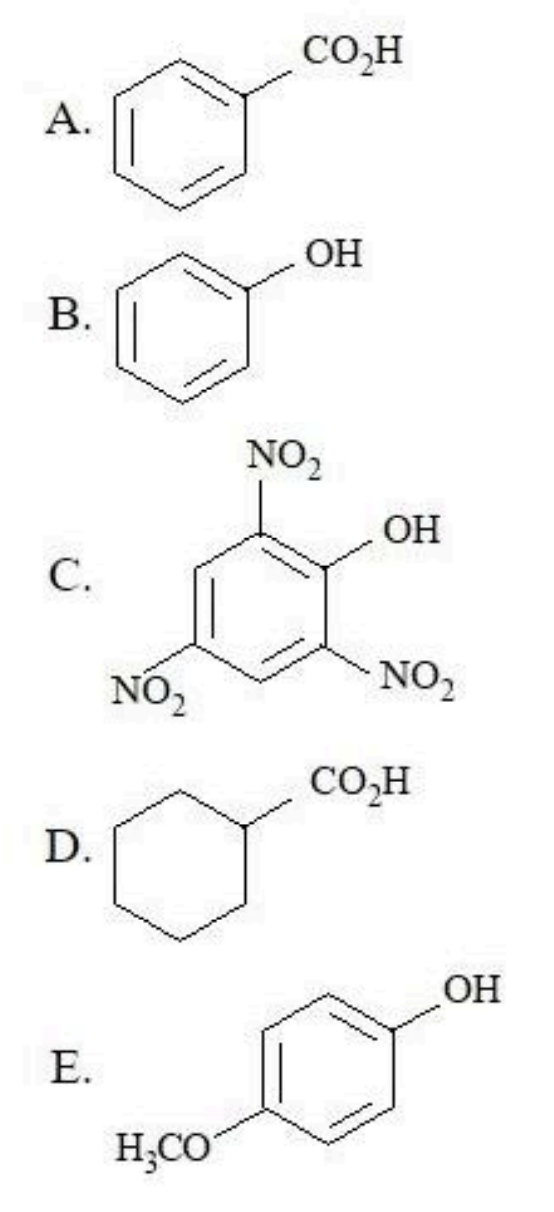
Five labeled organic structures A to E: benzoic acid, phenol, 2,4,6-trinitrophenol, cyclohexanecarboxylic acid, and p-methoxyphenol.
  • A

    A and C Only

  • B

    A, B, and E Only

  • C

    A, C, and D Only

  • D

    A and B Only

Answer

Correct answer:C

Step-by-step solution

Standard Method

Given: We must identify which compounds produce CO2CO_2 with aqueous NaHCO3NaHCO_3 solution.

Find: The correct set of compounds.

Aqueous sodium bicarbonate, NaHCO3NaHCO_3, reacts with compounds that are sufficiently acidic. Carboxylic acids react with NaHCO3NaHCO_3 to liberate CO2CO_2. Ordinary phenols are weaker acids than carbonic acid and usually do not react, but strongly electron-withdrawing groups can increase phenolic acidity enough for reaction.

From the given compounds:

  • A. Benzoic acid is a carboxylic acid, so it reacts with NaHCO3NaHCO_3 and produces CO2CO_2.
  • B. Phenol is a weak acid and does not react with NaHCO3NaHCO_3.
  • C. Picric acid (2,4,6-trinitrophenol) is a strongly acidic phenol because of three nitro groups, so it reacts with NaHCO3NaHCO_3 and produces CO2CO_2.
  • D. Cyclohexanecarboxylic acid is a carboxylic acid, so it reacts with NaHCO3NaHCO_3 and produces CO2CO_2.
  • E. 4-Methoxyphenol is a weak phenol and does not react with NaHCO3NaHCO_3.

Therefore, the compounds that produce CO2CO_2 are A, C, and D only. The correct option is C.

Acidity Comparison Method

Given: Compounds A to E are tested with aqueous NaHCO3NaHCO_3.

Find: Which ones evolve CO2CO_2.

Only acids stronger than carbonic acid react with sodium bicarbonate. Thus, the key comparison is acidity.

  • Carboxylic acids are sufficiently acidic and give CO2CO_2.
  • Phenol is not acidic enough and does not give CO2CO_2.
  • Strongly electron-withdrawing substituents such as nitro groups can make a phenol acidic enough to react.

Applying this to each compound:

  1. A = Benzoic acid → carboxylic acid → reacts.
  2. B = Phenol → weak phenol → does not react.
  3. C = 2,4,6-Trinitrophenol → three NO2NO_2 groups strongly increase acidity → reacts.
  4. D = Cyclohexanecarboxylic acid → carboxylic acid → reacts.
  5. E = p-Methoxyphenol → methoxy group is electron-donating, so acidity decreases → does not react.

Hence the compounds producing CO2CO_2 are A, C, and D only. Therefore, the correct option is C.

Common mistakes

  • Assuming all phenols react with aqueous NaHCO3NaHCO_3. This is wrong because ordinary phenols are weaker acids than carbonic acid. Check whether the phenol is made strongly acidic by electron-withdrawing groups before predicting CO2CO_2 evolution.

  • Ignoring the effect of substituents on acidity. This is wrong because three nitro groups in picric acid greatly increase acidity, while a methoxy group decreases phenolic acidity. Evaluate substituent effects before deciding reactivity with NaHCO3NaHCO_3.

  • Treating all acidic-looking compounds as equally reactive. This is wrong because bicarbonate reacts only with sufficiently acidic compounds. Distinguish carboxylic acids from weakly acidic phenols.

Practice more Carboxylic Acids questions

Get unlimited AI-adaptive practice, mastery tracking, and an AI tutor that explains every step — free to start.

Related questions