MCQMediumJEE 2026Carboxylic Acids

JEE Chemistry 2026 Question with Solution

Compound 'P' undergoes the following sequence of reactions : (i) NH₃ (ii) Δ\Delta \rightarrow Q (i) KOH, Br₂ (ii) CHCl₃, KOH (alc), Δ\Delta \rightarrow NC-CH₃. 'P' is :

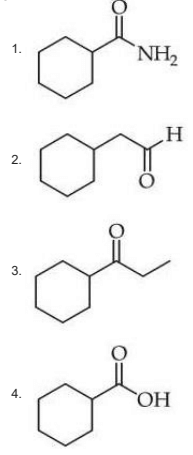
Reaction sequence showing compound P treated with ammonia and heat to give Q, then with potassium hydroxide and bromine followed by chloroform, alcoholic potassium hydroxide, and heat to form methyl isocyanide.Four option structures are shown: cyclohexanecarboxamide, cyclohexylacetaldehyde, cyclohexyl ethyl ketone, and cyclohexanecarboxylic acid.
  • A

    1.1.

  • B

    2.2.

  • C

    3.3.

  • D

    4.4.

Answer

Correct answer:D

Step-by-step solution

Standard Method

Given: Compound 'P' undergoes reaction with NH₃ on heating to form Q. Then Q undergoes Hofmann bromamide reaction with KOH, Br₂ and the product further gives NC-CH₃ in carbylamine reaction with CHCl₃, KOH (alc), \Delta.

Find: The identity of compound 'P'.

The carbylamine reaction gives an isocyanide only from a primary amine. Since the final product is CH3NCCH_3NC, the amine before this step must be CH3NH2CH_3NH_2.

In Hofmann bromamide degradation, an amide gives a primary amine with one carbon less than the parent amide. Therefore, to obtain CH3NH2CH_3NH_2, compound Q must be ethanamide, CH3CONH2CH_3CONH_2.

Now Q is formed from 'P' by reaction with NH₃ followed by heating. This is the conversion of a carboxylic acid into its corresponding amide. Hence 'P' must be ethanoic acid, CH3COOHCH_3COOH.

Among the given structures, option 4 represents the corresponding carboxylic acid structure in the set shown. Therefore, the correct option is D.

Working Backward from the Final Product

Given: The final product is NC-CH₃.

Find: Which starting compound 'P' can produce it through the given sequence?

Step 1: Use the last reaction first. The reagents CHCl₃ and KOH (alc) with heat indicate the carbylamine reaction, which converts a primary amine into an isocyanide.

So,

CH3NH2CH3NCCH_3NH_2 \rightarrow CH_3NC

Step 2: The previous reagents Br₂/KOH indicate the Hofmann bromamide reaction. In this reaction, the amide loses the carbonyl carbon and forms a primary amine with one less carbon.

Therefore,

CH3CONH2CH3NH2CH_3CONH_2 \rightarrow CH_3NH_2

Step 3: The first step uses NH₃ and heat, which converts a carboxylic acid into the corresponding amide.

Thus,

CH3COOHCH3CONH2CH_3COOH \rightarrow CH_3CONH_2

So the starting compound 'P' is the carboxylic acid corresponding to ethanamide. Hence the correct choice is option 4, that is D.

Common mistakes

  • Confusing the carbylamine reaction with cyanide formation. The reaction with CHCl₃/KOH gives an isocyanide from a primary amine, not a nitrile. Work backward through the primary amine intermediate.

  • Forgetting that the Hofmann bromamide reaction removes the carbonyl carbon. Because of this, the amine formed has one fewer carbon than the amide. Do not keep the same carbon count.

  • Identifying Q directly as a primary amine after reaction with NH₃ and heat. That step forms an amide from the corresponding carboxylic acid, not the final amine.

Practice more Carboxylic Acids questions

Get unlimited AI-adaptive practice, mastery tracking, and an AI tutor that explains every step — free to start.

Related questions