MCQMediumJEE 2026Carboxylic Acids

JEE Chemistry 2026 Question with Solution

Consider the following reaction sequence:
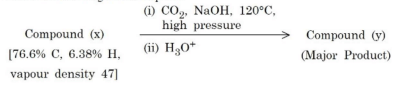
Reaction scheme showing compound x converting to compound y using CO2 and NaOH at 120°C under high pressure, followed by H3O+, with notes that x has 76.6% C, 6.38% H, vapour density 47, and y is the major product.

Given: Compound xx has percentage composition 76.6% C76.6\%\ C, 6.38% H6.38\%\ H and vapour density =47=47. Compound yy develops a characteristic colour with neutral FeCl3\mathrm{FeCl_3} solution. Identify the INCORRECT statement.

  • A

    Compound yy will dissolve in NaHCO3\mathrm{NaHCO_3} and evolve a gas.

  • B

    Both compounds xx and yy will burn with sooty flame.

  • C

    Compound xx is more acidic than compound yy.

  • D

    Both compounds xx and yy will dissolve in NaOH\mathrm{NaOH}.

Answer

Correct answer:C

Step-by-step solution

Standard Method

Given: Compound xx has percentage composition 76.6% C76.6\%\ C, 6.38% H6.38\%\ H and vapour density 4747. Compound yy gives a characteristic colour with neutral FeCl3\mathrm{FeCl_3} solution.

Find: The incorrect statement.

From vapour density,

Molecular mass=2×47=94\text{Molecular mass} = 2 \times 47 = 94

Let the molecular formula be CxHyOz\mathrm{C_xH_yO_z}.

From percentage composition,

12x94×100=76.6x6\frac{12x}{94} \times 100 = 76.6 \Rightarrow x \approx 6 y94×100=6.38y6\frac{y}{94} \times 100 = 6.38 \Rightarrow y \approx 6

Thus, compound xx is C6H6O\mathrm{C_6H_6O}, which is phenol.

The reaction with CO2+NaOH\mathrm{CO_2 + NaOH} under high pressure and temperature followed by acidification is the Kolbe–Schmitt reaction. Therefore, compound yy is salicylic acid.

Salicylic acid gives a characteristic colour with neutral FeCl3\mathrm{FeCl_3}, which supports this identification.

Now evaluate the statements:

(A) Salicylic acid contains a COOH-\mathrm{COOH} group and reacts with NaHCO3\mathrm{NaHCO_3} to release CO2\mathrm{CO_2} gas. Hence this statement is correct.

(B) Both phenol and salicylic acid are aromatic compounds, so they burn with a sooty flame. Hence this statement is correct.

(C) Phenol is less acidic than salicylic acid. Salicylic acid is significantly more acidic because of the carboxylic acid group. Therefore this statement is incorrect.

(D) Both phenol and salicylic acid dissolve in NaOH\mathrm{NaOH} due to salt formation. Hence this statement is correct.

Therefore, the incorrect statement is C.

Identification of the compounds

Given: The empirical information for compound xx and the reaction conditions.

Find: The identities of xx and yy before checking the statements.

First identify xx using molecular mass and composition.

Molecular mass of x=2×47=94\text{Molecular mass of } x = 2 \times 47 = 94

For carbon,

12x94×100=76.6\frac{12x}{94} \times 100 = 76.6

which gives x6x \approx 6.

For hydrogen,

y94×100=6.38\frac{y}{94} \times 100 = 6.38

which gives y6y \approx 6.

So the formula is C6H6O\mathrm{C_6H_6O}. The common aromatic compound with this formula is phenol.

Next identify yy. Phenol on treatment with CO2/NaOH\mathrm{CO_2/NaOH} under pressure and temperature followed by acidification gives salicylic acid by the Kolbe–Schmitt reaction.

Also, neutral FeCl3\mathrm{FeCl_3} gives a characteristic colour with phenolic compounds such as salicylic acid. Hence yy is salicylic acid.

Since phenol is less acidic than salicylic acid, option C is the incorrect statement.

Common mistakes

  • Confusing the acidity order of phenol and salicylic acid. This is wrong because carboxylic acids are stronger acids than phenols. Compare the functional groups first, then judge acidity.

  • Failing to use vapour density to obtain molecular mass. This is wrong because the identity of compound xx depends on molecular mass=2×vapour density\text{molecular mass} = 2 \times \text{vapour density}. Compute the molar mass before matching the formula.

  • Assuming neutral FeCl3\mathrm{FeCl_3} test is only for simple phenol and ignoring salicylic acid. This is wrong because salicylic acid still contains a phenolic OH-\mathrm{OH} group. Check all functional groups present in the product.

Practice more Carboxylic Acids questions

Get unlimited AI-adaptive practice, mastery tracking, and an AI tutor that explains every step — free to start.

Related questions