
Consider the following molecules:
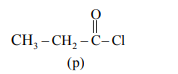
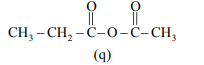
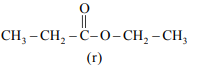
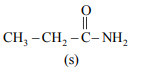
The order of rate of hydrolysis is:
- A
- B
- C
- D
Consider the following molecules:
The order of rate of hydrolysis is:
Correct answer:D
Standard Method
Given: Four carboxylic acid derivatives , , and are given.
Find: The correct order of rate of hydrolysis.
Hydrolysis of carboxylic acid derivatives proceeds through nucleophilic acyl substitution. The rate depends mainly on:
The leaving groups are:
From the strength of their conjugate acids,
so the basicity order of the leaving groups is
Therefore, leaving group ability is
Hence the hydrolysis rate order is
This is also supported by electrophilicity: acyl chloride is most reactive, then anhydride, then ester, and amide is least reactive.
Therefore, the correct order of rate of hydrolysis is . The correct option is D.
The solution marks option C, but its own working concludes . Hence the worked solution supports D, not C.
Comparing only the names of the derivatives without checking the leaving group. Hydrolysis rate is controlled strongly by leaving group ability, so first identify which group departs in each case.
Assuming ester hydrolyses faster than anhydride because both contain oxygen. This is incorrect because carboxylate is a much better leaving group than alkoxide.
Ignoring resonance donation in amides. In , nitrogen donates strongly by resonance, reducing carbonyl electrophilicity and making amides the least reactive toward hydrolysis.
Get unlimited AI-adaptive practice, mastery tracking, and an AI tutor that explains every step — free to start.