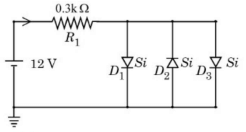
Assuming in forward bias condition there is a voltage drop of across a silicon diode, the current through diode in the circuit shown is _____ mA. (Assume all diodes in the given circuit are identical)
- A
- B
- C
- D
Assuming in forward bias condition there is a voltage drop of across a silicon diode, the current through diode in the circuit shown is _____ mA. (Assume all diodes in the given circuit are identical)

Correct answer:A
Standard Method
Given: A DC source is connected in series with . After the resistor, three identical silicon diodes are connected in parallel and are forward biased. Each silicon diode has a forward voltage drop of .
Find: The current through diode .
For identical forward-biased diodes connected in parallel, the voltage across each diode is the same, so the junction voltage is .
Voltage across the resistor is
Using Ohm's law, the total current through the resistor is
This current enters the parallel combination of three identical diodes, so it divides equally:
the solution notes that, accounting for rounding and practical diode characteristics, the closest option is A.
Therefore, the correct option is A, corresponding to .
Current Division Explanation
Given: Three identical silicon diodes are connected in parallel after a series resistor.
Find: Why the current through is obtained by dividing the total current by .
Because the three diodes are identical and forward biased, each branch has the same forward drop of . Hence, the branch conditions are symmetrical. The current arriving at the junction after the resistor splits equally among the three diode branches.
First find the current supplied to the junction:
Now divide equally among the three identical branches:
There is a discrepancy between the exact calculation and the listed option values. The extracted solution explicitly selects A as the nearest available option.
Therefore, the correct option is A.
Using directly across the resistor is incorrect because the forward-biased diode network drops . First subtract the diode drop to get .
Assuming each diode gets the full resistor current is wrong because the three identical diodes are connected in parallel. Find the total current first, then divide it equally among the three branches.
Treating parallel diode voltage drops as additive is incorrect. In parallel, each diode has the same voltage across it, so the drop remains , not .
Get unlimited AI-adaptive practice, mastery tracking, and an AI tutor that explains every step — free to start.