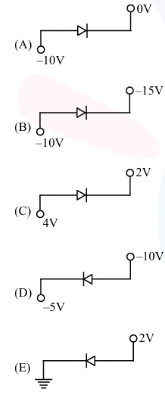
Which of the following circuits represents a forward biased diode?
- A
(B), (D) and (E) only
- B
(A) and (D) only
- C
(B), (C) and (E) only
- D
(C) and (E) only
Which of the following circuits represents a forward biased diode?

(B), (D) and (E) only
(A) and (D) only
(B), (C) and (E) only
(C) and (E) only
Correct answer:C
Standard Method
Given: Five diode circuits (A) to (E) are shown with different polarities and node voltages.
Find: Which circuits have the diode in forward bias.
A diode is forward biased when the anode is at a higher potential than the cathode. In that case, current can flow through the diode.
Check each circuit one by one using the shown polarity and diode orientation:
Therefore, the circuits representing forward biased diode are (B), (C) and (E) only. Hence, the correct option is C.
Circuit-wise Check
Given: Forward bias condition for a diode.
Find: The correct set among the given options.
Condition for forward bias: the diode conducts only when the anode is connected to a higher potential and the cathode is connected to a lower potential. This reduces the barrier and allows current through the diode.
Applying this condition:
So the forward biased diodes are B, C, and E only. Thus, the correct option is C.
Mistake: Judging forward bias only from the battery symbol direction without checking which side is anode and which is cathode. Why wrong: diode bias depends on potential difference across its terminals, not just visual orientation. Do instead: identify the diode bar side as cathode and compare terminal potentials.
Mistake: Assuming the side with a positive numerical value is always forward biased. Why wrong: even negative voltages can produce forward bias if the anode is at a higher potential than the cathode, for example is higher than . Do instead: compare the two potentials numerically.
Mistake: Ignoring diode orientation in circuits (D) and (E) and treating similar voltage labels as identical cases. Why wrong: reversing the diode flips anode and cathode, changing forward bias to reverse bias or vice versa. Do instead: first mark anode and cathode from the symbol, then compare potentials.
Get unlimited AI-adaptive practice, mastery tracking, and an AI tutor that explains every step — free to start.