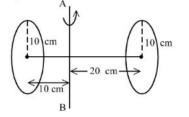
Given: Two discs each of mass 0.6kg and radius 0.1m are connected by a rod of length 0.3m and mass 0.6kg. The applied torque is 43×10−7dyne\cdotcm.
Find: Angular acceleration about axis AB.
Concept:
α=Iτ
where τ is the applied torque and I is the moment of inertia of the system about the given axis.
Step 1: Convert given quantities into SI units
Mass of each disc=600g=0.6kg
Mass of rod=600g=0.6kg
r=10cm=0.1m
Given torque:
43×10−7dyne\cdotcm
Since
1dyne\cdotcm=10−7N\cdotm
τ=43×10−14N\cdotmStep 2: Moment of inertia of each disc about axis AB
The axis AB passes through the midpoint of the rod. Each disc centre is at a distance of 0.2m from the axis.
Moment of inertia of a disc about its own central axis:
Idisc,cm=21mr2=21(0.6)(0.1)2=0.003kg m2
Using parallel axis theorem:
Idisc=Idisc,cm+md2=0.003+0.6(0.2)2=0.003+0.024=0.027
For two discs:
Idiscs=2×0.027=0.054Step 3: Moment of inertia of the rod
The rod rotates about an axis through its centre and perpendicular to its length:
Irod=121ML2=121(0.6)(0.3)2=0.0045Step 4: Total moment of inertia
Itotal=0.054+0.0045=0.0585kg m2Step 5: Calculate angular acceleration
α=0.058543×10⁻¹⁴≈11rad s−2
Therefore, the angular acceleration is 11rad s−2 and the correct option is D.