NVAEasyJEE 2023Theorems of M.I (Parallel & Perpendicular Axis)

JEE Physics 2023 Question with Solution

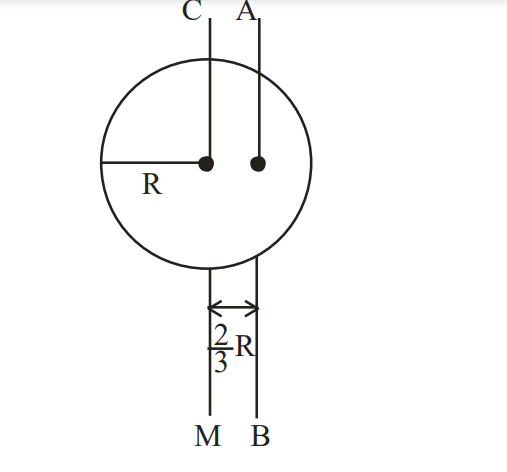
ICMI_{CM} is the moment of inertia of a circular disc about an axis (CM) passing through its center and perpendicular to the plane of the disc. IABI_{AB} is its moment of inertia about an axis ABAB perpendicular to the plane and parallel to axis CMCM at a distance 23R\frac{2}{3} R from the center, where RR is the radius of the disc. The ratio of IABI_{AB} and ICMI_{CM} is x:9x : 9. The value of xx is:

A circular disc with central axis CM and a parallel axis AB drawn to the right, separated by a distance 2R/3. Radius R is marked from the center to the left edge of the disc.

Answer

Correct answer:17

Step-by-step solution

Standard Method

Given: ICMI_{CM} is the moment of inertia of a disc about the central axis perpendicular to its plane. The parallel axis ABAB is at a distance 2R3\frac{2R}{3} from the center.

Find: The value of xx if IAB:ICM=x:9I_{AB} : I_{CM} = x : 9.

For a circular disc about its central perpendicular axis,

ICM=12mR2I_{CM} = \frac{1}{2} mR^2

Using the parallel axis theorem,

IAB=ICM+md2I_{AB} = I_{CM} + md^2

where

d=2R3d = \frac{2R}{3}

So,

IAB=12mR2+m(2R3)2I_{AB} = \frac{1}{2} mR^2 + m\left(\frac{2R}{3}\right)^2 IAB=12mR2+49mR2I_{AB} = \frac{1}{2} mR^2 + \frac{4}{9} mR^2 IAB=918mR2+818mR2=1718mR2I_{AB} = \frac{9}{18} mR^2 + \frac{8}{18} mR^2 = \frac{17}{18} mR^2

Now,

IABICM=1718mR212mR2=179\frac{I_{AB}}{I_{CM}} = \frac{\frac{17}{18} mR^2}{\frac{1}{2} mR^2} = \frac{17}{9}

Thus,

IAB:ICM=17:9I_{AB} : I_{CM} = 17 : 9

Therefore, the value of xx is 1717.

Ratio Comparison

Given: ICM=12mR2I_{CM} = \frac{1}{2}mR^2 and the new axis is parallel to it at distance 2R3\frac{2R}{3}.

Find: The ratio parameter xx.

By the parallel axis theorem,

IAB=ICM+m(2R3)2I_{AB} = I_{CM} + m\left(\frac{2R}{3}\right)^2

Substitute ICM=12mR2I_{CM} = \frac{1}{2}mR^2:

IAB=12mR2+49mR2I_{AB} = \frac{1}{2}mR^2 + \frac{4}{9}mR^2

Taking LCM 1818,

IAB=918mR2+818mR2=1718mR2I_{AB} = \frac{9}{18}mR^2 + \frac{8}{18}mR^2 = \frac{17}{18}mR^2

Now compare with ICMI_{CM}:

ICM=12mR2=918mR2I_{CM} = \frac{1}{2}mR^2 = \frac{9}{18}mR^2

Hence,

IAB:ICM=1718mR2:918mR2=17:9I_{AB} : I_{CM} = \frac{17}{18}mR^2 : \frac{9}{18}mR^2 = 17 : 9

So the required value is 1717.

Common mistakes

  • Using the wrong basic formula for the disc, such as I=mR2I = mR^2. This is incorrect because for a circular disc about the central axis perpendicular to its plane, the correct expression is ICM=12mR2I_{CM} = \frac{1}{2}mR^2. Start with the standard disc formula before applying the shift.

  • Applying the parallel axis theorem with d=Rd = R instead of d=2R3d = \frac{2R}{3}. This is wrong because the axis ABAB is specifically given at a distance 2R3\frac{2R}{3} from the center. Always use the stated separation between the two parallel axes.

  • Adding the shifted term incorrectly as m(2R3)m\left(\frac{2R}{3}\right) instead of squaring the distance. The theorem requires md2md^2, not mdmd. First square the offset, then multiply by mm.

Practice more Theorems of M.I (Parallel & Perpendicular Axis) questions

Get unlimited AI-adaptive practice, mastery tracking, and an AI tutor that explains every step — free to start.

Related questions