MCQMediumJEE 2026Theorems of M.I (Parallel & Perpendicular Axis)

JEE Physics 2026 Question with Solution

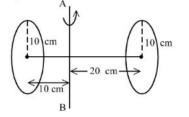
Two circular discs of radius 10cm10 \, \text{cm} each are joined at their centres by a rod, as shown in the figure. The length of the rod is 30cm30 \, \text{cm} and its mass is 600g600 \, \text{g}. The mass of each disc is also 600g600 \, \text{g}. If the applied torque between the two discs is 43×107dyne\cdotcm43\times10^{-7} \, \text{dyne\cdot cm}, then the angular acceleration of the system about the given axis ABAB is _____ rad s2\text{rad s}^{-2}.

Two circular discs connected by a horizontal rod, each disc of radius 10 cm, with a vertical axis AB through the midpoint and distance 20 cm marked from the axis to each disc centre.
  • A

    2222

  • B

    100100

  • C

    2727

  • D

    1111

Answer

Correct answer:D

Step-by-step solution

Standard Method

Given: Two discs each of mass 0.6kg0.6 \, \text{kg} and radius 0.1m0.1 \, \text{m} are connected by a rod of length 0.3m0.3 \, \text{m} and mass 0.6kg0.6 \, \text{kg}. The applied torque is 43×107dyne\cdotcm43\times10^{-7} \, \text{dyne\cdot cm}.

Find: Angular acceleration about axis ABAB.

Concept:

α=τI\alpha = \frac{\tau}{I}

where τ\tau is the applied torque and II is the moment of inertia of the system about the given axis.

Step 1: Convert given quantities into SI units

Mass of each disc=600g=0.6kg\text{Mass of each disc} = 600 \, \text{g} = 0.6 \, \text{kg} Mass of rod=600g=0.6kg\text{Mass of rod} = 600 \, \text{g} = 0.6 \, \text{kg} r=10cm=0.1mr = 10 \, \text{cm} = 0.1 \, \text{m}

Given torque:

43×107dyne\cdotcm43\times10^{-7} \, \text{dyne\cdot cm}

Since

1dyne\cdotcm=107N\cdotm1 \, \text{dyne\cdot cm} = 10^{-7} \, \text{N\cdot m} τ=43×1014N\cdotm\tau = 43\times10^{-14} \, \text{N\cdot m}

Step 2: Moment of inertia of each disc about axis ABAB The axis ABAB passes through the midpoint of the rod. Each disc centre is at a distance of 0.2m0.2 \, \text{m} from the axis.

Moment of inertia of a disc about its own central axis:

Idisc,cm=12mr2=12(0.6)(0.1)2=0.003kg m2I_{\text{disc,cm}} = \frac{1}{2}mr^2 = \frac{1}{2}(0.6)(0.1)^2 = 0.003 \, \text{kg m}^2

Using parallel axis theorem:

Idisc=Idisc,cm+md2=0.003+0.6(0.2)2=0.003+0.024=0.027I_{\text{disc}} = I_{\text{disc,cm}} + md^2 = 0.003 + 0.6(0.2)^2 = 0.003 + 0.024 = 0.027

For two discs:

Idiscs=2×0.027=0.054I_{\text{discs}} = 2\times0.027 = 0.054

Step 3: Moment of inertia of the rod The rod rotates about an axis through its centre and perpendicular to its length:

Irod=112ML2=112(0.6)(0.3)2=0.0045I_{\text{rod}} = \frac{1}{12}ML^2 = \frac{1}{12}(0.6)(0.3)^2 = 0.0045

Step 4: Total moment of inertia

Itotal=0.054+0.0045=0.0585kg m2I_{\text{total}} = 0.054 + 0.0045 = 0.0585 \, \text{kg m}^2

Step 5: Calculate angular acceleration

α=43×10140.058511rad s2\alpha = \frac{43\times10^{-14}}{0.0585} \approx 11 \, \text{rad s}^{-2}

Therefore, the angular acceleration is 11rad s211 \, \text{rad s}^{-2} and the correct option is D.

Common mistakes

  • Using only the moment of inertia of the discs about their own centres is incorrect because the axis ABAB does not pass through the centres of the discs. Use the parallel axis theorem and add md2md^2 for each disc.

  • Ignoring the rod's moment of inertia is incorrect because the rod also rotates about axis ABAB and contributes to the total rotational inertia. Include Irod=112ML2I_{\text{rod}} = \frac{1}{12}ML^2.

  • Making a unit-conversion error in torque can change the answer drastically. Convert dyne·cm to SI carefully before substitution instead of mixing cgs and SI units in the same calculation.

Practice more Theorems of M.I (Parallel & Perpendicular Axis) questions

Get unlimited AI-adaptive practice, mastery tracking, and an AI tutor that explains every step — free to start.

Related questions