MCQMediumJEE 2026Theorems of M.I (Parallel & Perpendicular Axis)
JEE Physics 2026 Question with Solution
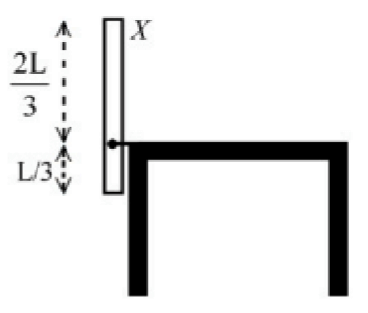
A thin uniform rod (X) of mass M and length L is pivoted at a height (3L) as shown in the figure. The rod is allowed to fall from a vertical position and lie horizontally on the table. The angular velocity of this rod when it hits the table top is _____. (g = gravitational acceleration)
A
2L3g
B
23Lg
C
L3g
D
21Lg
Answer
Correct answer:C
Step-by-step solution
Standard Method
Given: A thin uniform rod of mass M and length L is pivoted at a point such that the pivot is at a height 3L from one end. The rod falls from vertical to horizontal.
Find: The angular velocity ω when the rod hits the table top.
Use conservation of mechanical energy. The loss in gravitational potential energy of the centre of mass becomes rotational kinetic energy about the pivot.
The centre of mass of the rod is at its midpoint. Initially, with the rod vertical, the centre of mass is above the pivot by
32L−2L=6L
So the vertical drop of the centre of mass is
h=6L
Now apply energy conservation:
Mgh=21Iω2
The moment of inertia of the rod about its centre is
Icm=121ML2
The distance of the centre of mass from the pivot is
6L
Using the parallel axis theorem,
I=Icm+M(6L)2I=121ML2+M(6L)2=91ML2
Substitute into the energy equation:
Mg(6L)=21(91ML2)ω2
Solving,
ω2=L3g
Therefore,
ω=L3g
So, the correct option is C.
Centre of Mass Drop and Pivot Inertia
Given: The rod rotates about a fixed pivot, not about its centre.
Find: Angular speed at the instant it becomes horizontal.
The key idea is to track the centre of mass and compute the moment of inertia about the pivot.
The rod length is L, so its centre of mass lies at 2L from either end.
The pivot is located at a height 3L from the lower end when the rod is vertical.
Hence the centre of mass is above the pivot by
2L−3L=6L
When the rod becomes horizontal, the centre of mass is level with the pivot, so the drop in height is exactly
6L
Thus the loss in potential energy is
ΔU=Mg(6L)
The rotational kinetic energy is
K=21Iω2
Now evaluate I about the pivot:
I=121ML2+M(6L)2I=121ML2+361ML2=91ML2
Now equate energies:
Mg(6L)=21(91ML2)ω2
Cancel M and simplify:
6gL=18L2ω23gL=L2ω2ω2=L3g
Hence,
ω=L3g
Therefore, the angular velocity is L3g.
Common mistakes
Using the moment of inertia about the centre of mass directly. This is wrong because the rod rotates about the pivot, not about its centre. Use the parallel axis theorem to find I=Icm+Md2.
Taking the centre of mass drop as 2L or 3L. This is wrong because the relevant height change is measured relative to the pivot. First locate the centre of mass and pivot, then compute the drop as 6L.
Equating the potential energy loss to translational kinetic energy instead of rotational kinetic energy. The rod is constrained to rotate about a fixed pivot, so the kinetic energy must be written as 21Iω2.
Practice more Theorems of M.I (Parallel & Perpendicular Axis) questions
Get unlimited AI-adaptive practice, mastery tracking, and an AI tutor that explains every step — free to start.