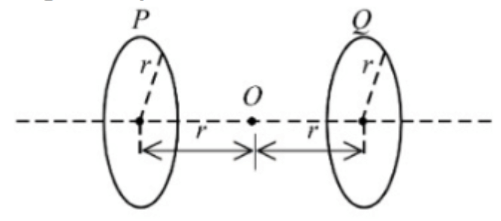
Two identical circular loops P and Q each of radius r are lying in parallel planes such that they have common axis. The current through P and Q are I and 4I respectively in clockwise direction as seen from O. The net magnetic field at O is:
A
42rμ0I towards Q
B
42rμ0I towards P
C
42r3μ0I towards P
D
42r3μ0I towards Q
Answer
Correct answer:C
Step-by-step solution
Standard Method
Given: Two identical circular loops P and Q have radius r. Currents are I and 4I respectively. Point O lies on the common axis, at distance r from each loop.
Find: The net magnetic field at O and its direction.
Magnetic field on the axis of a circular loop is
B=2(r2+x2)3/2μ0Ir2
where x is the distance of the point from the centre of the loop.
For loop P, current is I and x=r. Therefore,
BP=2(r2+r2)3/2μ0Ir2=2(2r2)3/2μ0Ir2=42rμ0I
Using the right-hand thumb rule, its direction is towards P.
The two magnetic fields are opposite in direction, so the net magnitude is
Bnet=BQ−BP=2rμ0I−42rμ0I=42r3μ0I
The solution states the direction of the net field is towards P.
Therefore, the correct option is C.
Direction and magnitude breakdown
Given: Both loops carry clockwise current as seen from O.
Find: Which field dominates at O.
First determine the direction of the field due to each loop using the right-hand thumb rule. At point O, the field due to loop P is towards P, while the field due to loop Q is towards Q. Hence the two fields oppose each other.
Now compare magnitudes using
B∝(r2+x2)3/2Ir2
Since both loops have the same radius and the point O is at the same distance r from each centre, the denominator is identical for both loops. Therefore, magnitudes are in the ratio of currents:
BP:BQ=I:4I=1:4
So the field due to loop Q is larger. The net field must therefore be in the direction associated with the larger field, as stated in the solution, giving magnitude
42r3μ0I
and direction towards P.
Therefore, the correct option is C.
Common mistakes
Students often add the magnitudes directly without checking direction. That is wrong because the magnetic fields due to the two loops are opposite at O. Use the right-hand thumb rule first, then subtract the magnitudes.
A common mistake is to use the magnetic field at the centre of a loop, B=2rμ0I. That is not applicable here because point O is on the axis at distance r from the centre. Use the axial field formula instead.
Some students substitute x=0 or forget that the distance from each loop centre to O is r. This gives an incorrect denominator. Here, x=r for both loops.
Practice more Biot–Savart Law questions
Get unlimited AI-adaptive practice, mastery tracking, and an AI tutor that explains every step — free to start.