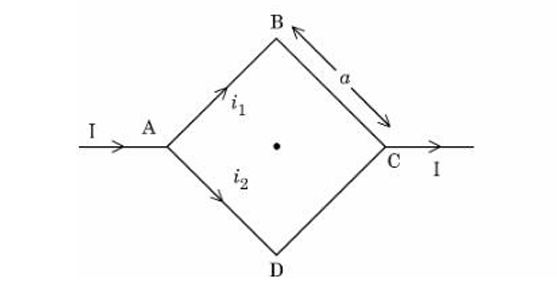
Figure shows a current carrying square loop ABCD of edge length is lying in a plane. If the resistance of the ABC part is and that of the ADC part is , then the magnitude of the resultant magnetic field at the center of the square loop is:
- A
- B
- C
- D
Figure shows a current carrying square loop ABCD of edge length is lying in a plane. If the resistance of the ABC part is and that of the ADC part is , then the magnitude of the resultant magnetic field at the center of the square loop is:

Correct answer:A
Standard Method
Given: The resistance of path ABC is and that of path ADC is . The total current entering at A is .
Find: The magnitude of the resultant magnetic field at the center of the square loop.
Since the two paths are in parallel, the current divides inversely in proportion to their resistances. Therefore,
where flows through ABC and flows through ADC.
The magnetic fields at the center due to these two current paths are in opposite directions, so the net field is obtained by subtraction. Using the expression given in the solution working,
Simplifying,
Therefore, the correct option is A.
Note: The printed Option A appears as , but the solution working clearly gives . The answer has been resolved using the solution.
Using superposition of fields
Given: A current reaches point A and splits into two branches of a square loop. The branch ABC has resistance and branch ADC has resistance .
Find: Resultant magnetic field at the center.
From current division in parallel branches,
and
Hence,
Each branch produces magnetic field at the center, but because the currents circulate around the center in opposite senses, their fields oppose each other. Therefore, the effective current contribution is
Using the field expression quoted in the extracted solution,
So,
Thus, the magnitude of the resultant magnetic field at the center is , corresponding to Option A by the solution.
Using equal current in both branches. This is wrong because the two paths have resistances and , so the current divides inversely to resistance. Use current division to get and .
Adding the two magnetic field magnitudes directly. This is wrong because the two branch currents produce magnetic fields at the center in opposite directions. Subtract their contributions instead of adding them.
Using the full current for one branch field calculation. This is incorrect because no single branch carries the entire current after the split at A. First determine branch currents, then calculate the net field.
Get unlimited AI-adaptive practice, mastery tracking, and an AI tutor that explains every step — free to start.