MCQMediumJEE 2026Alkynes (Acidic Nature, Reactions)

JEE Chemistry 2026 Question with Solution

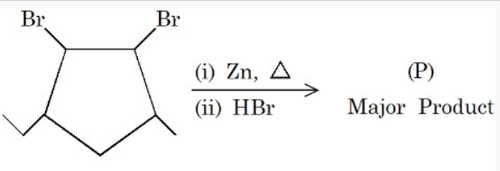
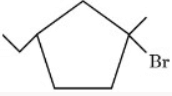
Cyclopentane ring bearing two bromine substituents on adjacent top carbons and a methyl substituent on the lower right carbon, followed by reagents Zn with heat and then HBr, asking to identify P as the major product precursor.

Identify (P)

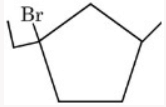
  • A
    Cyclopentane ring with a methyl substituent on the left carbon and both bromine and methyl attached to the top right carbon, representing 1-bromo-1-methylcyclopentane skeleton.
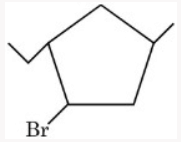
  • B
    Cyclopentane ring with bromine and an alkyl substituent attached to the same left upper carbon and a methyl substituent on the right upper carbon.
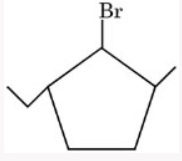
  • C
    Cyclopentane ring with a methyl substituent on the left upper carbon, a bromine on the adjacent lower left carbon, and another methyl substituent on the right upper carbon.
  • D
    Cyclopentane ring with bromine on the top carbon, a methyl substituent on the left upper carbon, and another methyl substituent on the right upper carbon.

Answer

Correct answer:A

Step-by-step solution

Standard Method

Given: Compound (P) on treatment with Zn/Δ\text{Zn}/\Delta gives an alkene, and subsequent addition of HBr\text{HBr} gives the major product shown.

Find: Identify (P).

Hint from the reaction sequence: Zn/Δ\text{Zn}/\Delta converts a vicinal dibromide into an alkene by dehalogenation. Then HBr\text{HBr} adds to that alkene according to Markovnikov's rule.

Working backwards, the final product is 1-bromo-1-methylcyclopentane, which is a tertiary bromide.

So the alkene just before HBr\text{HBr} addition must be 1-methylcyclopentene, because Markovnikov addition of HBr\text{HBr} to 1-methylcyclopentene places Br\text{Br} on the more substituted carbon.

Now, 1-methylcyclopentene can be formed from (P) by treatment with Zn/Δ\text{Zn}/\Delta only if (P) is the corresponding vicinal dibromide.

Therefore, (P) must be 1,2-dibromo-1-methylcyclopentane. This corresponds to option A.

The correct option is A.

Common mistakes

  • Assuming Zn/Δ\text{Zn}/\Delta performs substitution instead of dehalogenation. It actually removes adjacent halogens from a vicinal dihalide to form an alkene. First identify the alkene intermediate, then reconstruct the dibromide precursor.

  • Applying anti-Markovnikov addition for HBr\text{HBr} here. In the absence of peroxide conditions, HBr\text{HBr} adds by Markovnikov's rule, so bromine goes to the more substituted carbon.

  • Choosing a monobromo cyclopentane option directly as (P). The sequence requires (P) to first lose two halogens with zinc, so the precursor must be a dibromide, not a simple alkyl bromide.

Practice more Alkynes (Acidic Nature, Reactions) questions

Get unlimited AI-adaptive practice, mastery tracking, and an AI tutor that explains every step — free to start.

Related questions