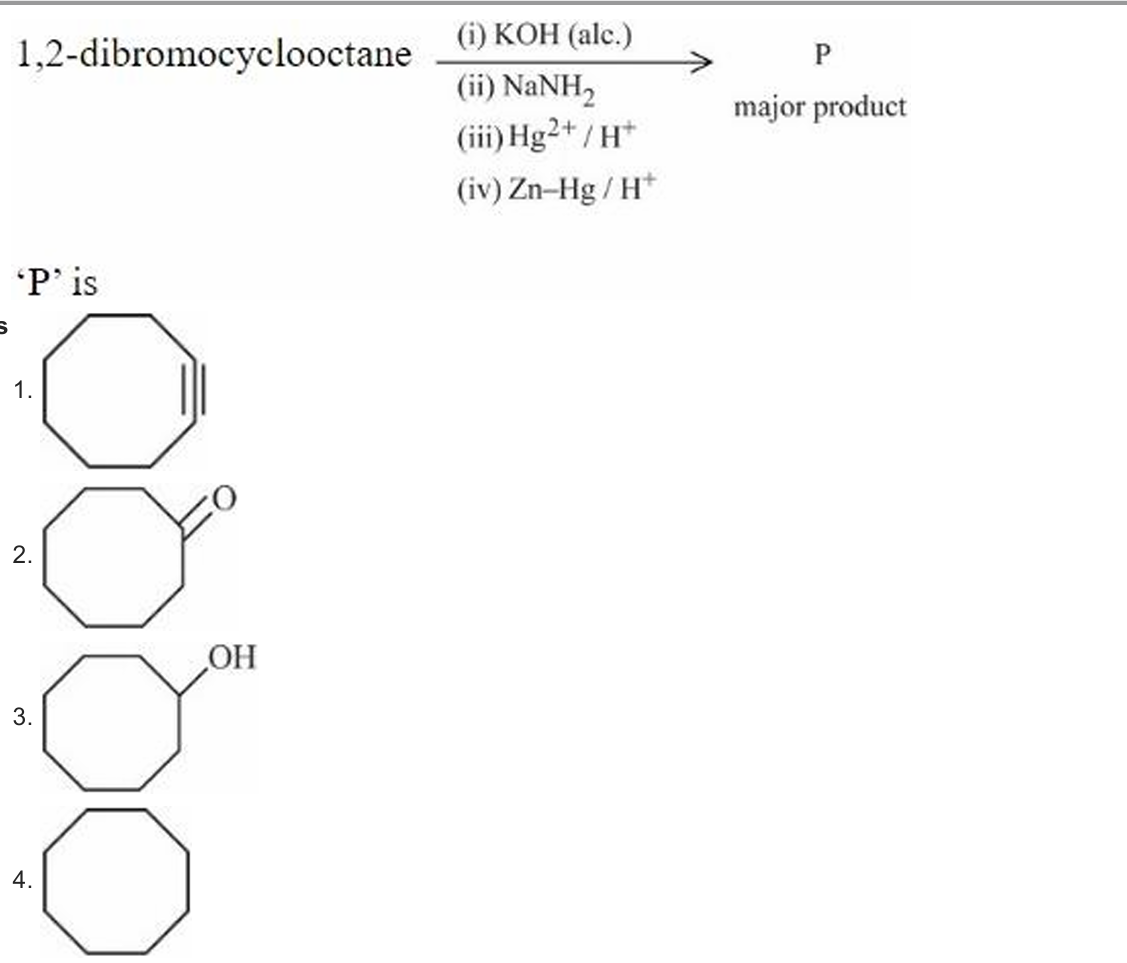
- A
Structure 1 shown in the figure.
- B
Structure 2 shown in the figure.
- C
Structure 3 shown in the figure.
- D
Structure 4 shown in the figure.

Structure 1 shown in the figure.
Structure 2 shown in the figure.
Structure 3 shown in the figure.
Structure 4 shown in the figure.
Correct answer:D
Standard Method
Given: 1,2-dibromocyclooctane is treated with , , , and .
Find: The major product .
The solution indicates that the first step is dehydrohalogenation with alcoholic KOH. This gives an unsaturated ring intermediate.
In the next step, acts as a strong base and further elimination gives a cyclic alkyne intermediate.
The later steps, followed by , convert the unsaturated intermediate into the fully saturated ring. Thus the final product corresponds to cyclooctane.
Therefore, the correct option is D.
Working from the provided approaches
Given: The reaction sequence is read from the figure and the solution.
Find: Which of the four drawn structures is .
From the second approach on the solution:
Among the four structures shown in the image, the fully saturated eight-membered ring is option 4.
The first approach text on the page contains inconsistent intermediate discussion, but the page explicitly states "The Correct Option is D". Therefore the answer is taken as D.
Assuming the reaction stops after the elimination step is incorrect because the sequence includes additional reagents after . Always track the product through the entire reagent sequence.
Confusing the final product with the alkyne intermediate is a common error. The alkyne may form in between, but the asked product is after all four steps, not after step .
Ignoring the structure options in the figure can lead to choosing an intermediate not present as the final answer. Match the mechanistic outcome with the drawn options before concluding.
Get unlimited AI-adaptive practice, mastery tracking, and an AI tutor that explains every step — free to start.