MCQMediumJEE 2026Alkynes (Acidic Nature, Reactions)

JEE Chemistry 2026 Question with Solution

Consider the following reaction:
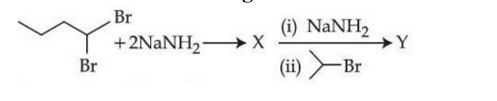
Reaction scheme showing a vicinal dibromide substrate treated first with excess sodium amide to form intermediate X, followed by sodium amide and isopropyl bromide to form product Y.

The product YY formed is:

  • A

    2-methylhex-3-yne

  • B

    2-methylhex-2-yne

  • C

    5-methylhex-2-yne

  • D

    Isopropylbut-1-yne

Answer

Correct answer:C

Step-by-step solution

Standard Method

Given: A vicinal dibromide is treated with excess NaNH2\text{NaNH}_2 to form intermediate XX, and then with NaNH2\text{NaNH}_2 followed by isopropyl bromide to form YY.

Find: The product YY.

Vicinal dihalides give alkynes on treatment with excess NaNH2\text{NaNH}_2, and terminal alkynes can be alkylated through acetylide ion formation.

Step 1: Formation of alkyne intermediate XX.

The given compound is a vicinal dibromide. On treatment with excess sodium amide (NaNH2)\left(\text{NaNH}_2\right), double dehydrohalogenation occurs, leading to the formation of a terminal alkyne XX.

Step 2: Formation of acetylide ion.

The terminal alkyne reacts with NaNH2\text{NaNH}_2 to form a sodium acetylide ion due to the acidic nature of the terminal hydrogen.

Step 3: Alkylation of acetylide ion.

The acetylide ion undergoes nucleophilic substitution with isopropyl bromide, resulting in carbon–carbon bond formation and chain extension.

Step 4: Identify the final product.

The alkylation introduces an isopropyl group at the terminal carbon of the alkyne, giving the final product:

5-methylhex-2-yne\text{5-methylhex-2-yne}

Therefore, the correct option is C.

Common mistakes

  • Assuming the vicinal dibromide gives an alkene after one elimination and stopping there is incorrect, because excess NaNH2\text{NaNH}_2 causes double dehydrohalogenation. Continue the reaction to the alkyne stage before identifying XX.

  • Missing the formation of the acetylide ion is incorrect, because a terminal alkyne reacts further with NaNH2\text{NaNH}_2 due to its acidic terminal hydrogen. Convert the terminal alkyne into its sodium acetylide before considering alkylation.

  • Placing the isopropyl group at the wrong carbon gives an incorrect name, because alkylation occurs at the terminal acetylide carbon through carbon–carbon bond formation. First extend the chain, then assign the longest chain and number the alkyne correctly.

Practice more Alkynes (Acidic Nature, Reactions) questions

Get unlimited AI-adaptive practice, mastery tracking, and an AI tutor that explains every step — free to start.

Related questions