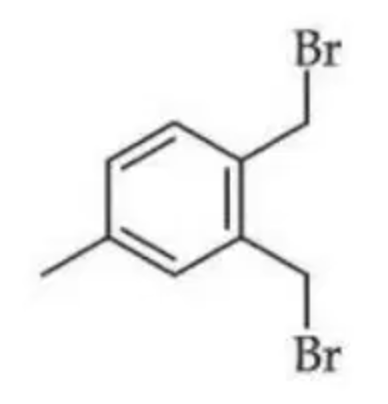
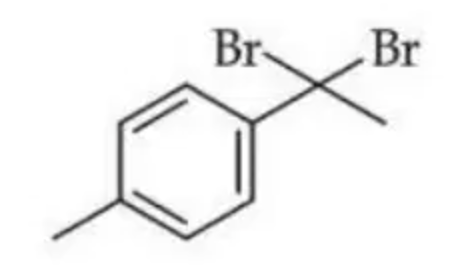
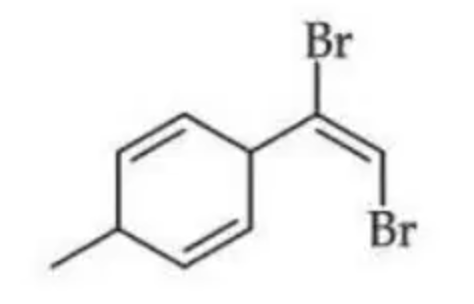
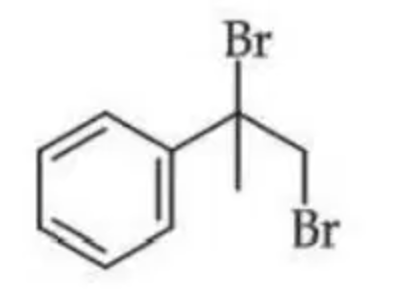
Given: A dibromo compound P with molecular formula C9H10Br2 gives Q on heating with excess sodamide followed by dilute HCl. Then Q on treatment with HgSO4/H2SO4 gives R. Compound R gives a positive iodoform test and a negative Tollens' test.
Find: The correct structure of P.
Step 1: Effect of excess sodamide.
Heating a vicinal or geminal dibromide with excess sodamide leads to double dehydrohalogenation, forming an alkyne. Hence, compound P must be such that it can form an alkyne Q.
Step 2: Reaction with HgSO4/H2SO4.
Hydration of an alkyne in the presence of mercuric sulphate and dilute sulphuric acid gives a ketone via enol–keto tautomerism.
Step 3: Analysis of tests on product R.
Positive iodoform test indicates the presence of a \ceCH3CO− group. Negative Tollens' test confirms the absence of an aldehyde group.
Thus, R must be a methyl ketone.
Step 4: Identify the correct structure.
Among the given options, only Option (C) on treatment with sodamide forms an alkyne that, upon mercuric sulphate hydration, yields a methyl ketone satisfying both test conditions.
Therefore, the correct option is C.