
Compound 'P' undergoes the following sequence of reactions : (i) NH₃ (ii) Q (i) KOH, Br₂ (ii) CHCl₃, KOH (alc), NC-CH₃. 'P' is :

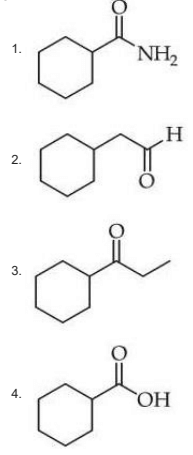
- A
- B
- C
- D
Compound 'P' undergoes the following sequence of reactions : (i) NH₃ (ii) Q (i) KOH, Br₂ (ii) CHCl₃, KOH (alc), NC-CH₃. 'P' is :
Correct answer:D
Standard Method
Given: Compound 'P' undergoes reaction with NH₃ on heating to form Q. Then Q undergoes Hofmann bromamide reaction with KOH, Br₂ and the product further gives NC-CH₃ in carbylamine reaction with CHCl₃, KOH (alc), \Delta.
Find: The identity of compound 'P'.
The carbylamine reaction gives an isocyanide only from a primary amine. Since the final product is , the amine before this step must be .
In Hofmann bromamide degradation, an amide gives a primary amine with one carbon less than the parent amide. Therefore, to obtain , compound Q must be ethanamide, .
Now Q is formed from 'P' by reaction with NH₃ followed by heating. This is the conversion of a carboxylic acid into its corresponding amide. Hence 'P' must be ethanoic acid, .
Among the given structures, option 4 represents the corresponding carboxylic acid structure in the set shown. Therefore, the correct option is D.
Working Backward from the Final Product
Given: The final product is NC-CH₃.
Find: Which starting compound 'P' can produce it through the given sequence?
Step 1: Use the last reaction first. The reagents CHCl₃ and KOH (alc) with heat indicate the carbylamine reaction, which converts a primary amine into an isocyanide.
So,
Step 2: The previous reagents Br₂/KOH indicate the Hofmann bromamide reaction. In this reaction, the amide loses the carbonyl carbon and forms a primary amine with one less carbon.
Therefore,
Step 3: The first step uses NH₃ and heat, which converts a carboxylic acid into the corresponding amide.
Thus,
So the starting compound 'P' is the carboxylic acid corresponding to ethanamide. Hence the correct choice is option 4, that is D.
Confusing the carbylamine reaction with cyanide formation. The reaction with CHCl₃/KOH gives an isocyanide from a primary amine, not a nitrile. Work backward through the primary amine intermediate.
Forgetting that the Hofmann bromamide reaction removes the carbonyl carbon. Because of this, the amine formed has one fewer carbon than the amide. Do not keep the same carbon count.
Identifying Q directly as a primary amine after reaction with NH₃ and heat. That step forms an amide from the corresponding carboxylic acid, not the final amine.
Get unlimited AI-adaptive practice, mastery tracking, and an AI tutor that explains every step — free to start.