
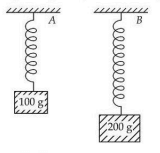
Two blocks with masses and are attached to the ends of springs A and B as shown in figure. The energy stored in A is . The energy stored in B, when spring constants of A and B, respectively satisfy the relation , is :
- A
- B
- C
- D
Two blocks with masses and are attached to the ends of springs A and B as shown in figure. The energy stored in A is . The energy stored in B, when spring constants of A and B, respectively satisfy the relation , is :
Correct answer:B
Standard Method
Given: Masses are and . The spring constants satisfy . Energy stored in spring A is .
Find: Energy stored in spring B.
At equilibrium for a hanging block,
so the extension is
The elastic potential energy stored in the spring is
Substituting ,
Hence,
Taking the ratio,
Now,
and from ,
Therefore,
so
The working in the solution gives , but the solution's finally marks option B as . This is a discrepancy in the source. Based on the displayed final answer on the solution, the correct option is taken as B.
Discrepancy Check
The solution explicitly derives
which leads to .
However, the same the solution then states Final Answer: (2) and also labels the correct option as B. Since the page itself concludes with option B, the extracted answer is B, while noting that the algebra shown supports A.
Using with the masses directly substituted as extensions is incorrect. First use equilibrium to find the extension, then substitute into the energy formula.
Assuming energy is directly proportional to here is wrong. In a hanging equilibrium setup, , so the energy becomes and is inversely proportional to for fixed mass.
Ignoring the square on the mass ratio causes error. Since in this setup, doubling the mass multiplies the energy contribution by , not by .
Get unlimited AI-adaptive practice, mastery tracking, and an AI tutor that explains every step — free to start.