A particle oscillates along the -axis according to the law, , where and is the time period of oscillation. The kinetic energy () of the particle as a function of is correctly represented by the graph:
- A
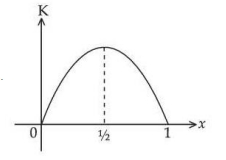
Graph 1:
- B
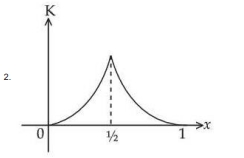
Graph 2:
- C
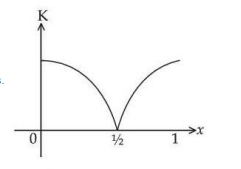
Graph 3:
- D
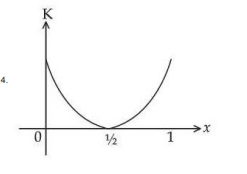
Graph 4:
A particle oscillates along the -axis according to the law, , where and is the time period of oscillation. The kinetic energy () of the particle as a function of is correctly represented by the graph:
Graph 1:

Graph 2:

Graph 3:

Graph 4:

Correct answer:A
Standard Method
Given: with .
Find: The correct graph of kinetic energy as a function of displacement .
The solution states that the correct option is A.
For the motion,
Using differentiation,
Now use ,
Hence,
so the kinetic energy is zero when the velocity is zero, and maximum at the मध्य position of the motion. Since varies from to , the graph of versus starts from zero at , becomes maximum at , and returns to zero at .
Therefore, the correct option is A (Graph 1).
Using displacement to express kinetic energy
Given: .
Find: The shape of the graph of as a function of .
Let
Then,
and from differentiation,
So,
Using
we get
Therefore,
With ,
This is a downward-opening parabola with zeros at and , and maximum at
So the required graph is the arch-shaped curve shown in Graph 1.
Therefore, the correct option is A.
Differentiating incorrectly as . This is wrong because the chain rule and the factor of are both required. Differentiate as .
Assuming kinetic energy is maximum at the extreme positions. This is wrong because at the extreme positions the velocity is zero, so there. Check where the speed is maximum before sketching the graph.
Not converting the time-dependent expression into a displacement-dependent one. This is wrong because the question asks for as a function of , not of . Use to eliminate time.
Get unlimited AI-adaptive practice, mastery tracking, and an AI tutor that explains every step — free to start.