MCQMediumJEE 2026Alkynes (Acidic Nature, Reactions)

JEE Chemistry 2026 Question with Solution

The dibromo compound PP (molecular formula: C9H10Br2C_9H_{10}Br_2) when heated with excess sodamide followed by treatment with dilute HCl gives QQ. On warming QQ with mercuric sulphate and dilute sulphuric acid yields RR, which gives a positive iodoform test but a negative Tollens' test. The compound PP is:

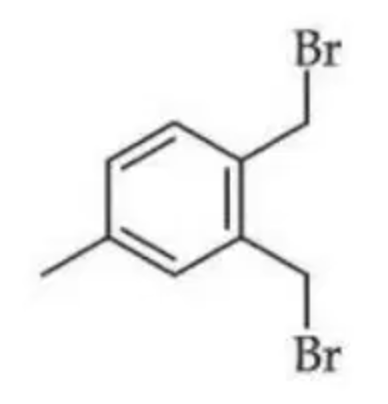
  • A
    Methyl-substituted benzene ring bearing two bromomethyl substituents on adjacent side-chain positions, one above and one below the ring on the right side.
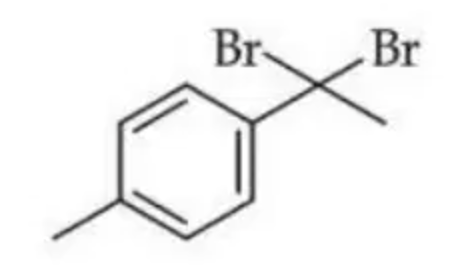
  • B
    Methyl-substituted benzene ring attached to a gem-dibrominated carbon center on the side chain, with two bromine atoms on the same external carbon.
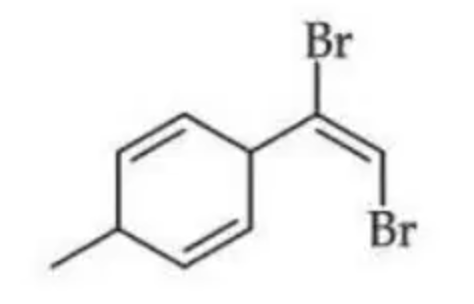
  • C
    Methyl-substituted benzene ring attached to a side chain containing a vinyl bromide and terminal bromomethyl arrangement, matching the third structure shown.
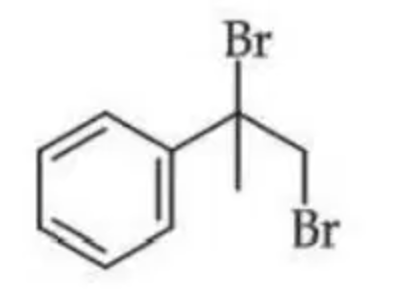
  • D
    Phenyl side-chain structure with one bromine on the benzylic carbon and another bromine on the terminal carbon of the short alkyl chain.

Answer

Correct answer:C

Step-by-step solution

Standard Method

Given: A dibromo compound PP with molecular formula C9H10Br2C_9H_{10}Br_2 gives QQ on heating with excess sodamide followed by dilute HCl. Then QQ on treatment with HgSO4/H2SO4HgSO_4/H_2SO_4 gives RR. Compound RR gives a positive iodoform test and a negative Tollens' test.

Find: The correct structure of PP.

Step 1: Effect of excess sodamide.

Heating a vicinal or geminal dibromide with excess sodamide leads to double dehydrohalogenation, forming an alkyne. Hence, compound PP must be such that it can form an alkyne QQ.

Step 2: Reaction with HgSO4/H2SO4HgSO_4/H_2SO_4.

Hydration of an alkyne in the presence of mercuric sulphate and dilute sulphuric acid gives a ketone via enol–keto tautomerism.

Step 3: Analysis of tests on product RR.

Positive iodoform test indicates the presence of a \ceCH3CO\ce{CH3CO-} group. Negative Tollens' test confirms the absence of an aldehyde group.

Thus, RR must be a methyl ketone.

Step 4: Identify the correct structure.

Among the given options, only Option (C) on treatment with sodamide forms an alkyne that, upon mercuric sulphate hydration, yields a methyl ketone satisfying both test conditions.

Therefore, the correct option is C.

Common mistakes

  • Assuming any dibromide will give the required product is incorrect because only a structure capable of double dehydrohalogenation to the right alkyne works. First check whether the dibromide can form an alkyne under excess sodamide.

  • Treating the positive iodoform test as evidence for an aldehyde is wrong. A positive iodoform test indicates a methyl ketone or a related precursor, while the negative Tollens' test rules out an aldehyde.

  • Ignoring the hydration outcome of the alkyne is a conceptual error. Under HgSO4/H2SO4HgSO_4/H_2SO_4, the alkyne must hydrate to a ketone, so choose the precursor whose alkyne gives a methyl ketone after enol–keto tautomerism.

Practice more Alkynes (Acidic Nature, Reactions) questions

Get unlimited AI-adaptive practice, mastery tracking, and an AI tutor that explains every step — free to start.

Related questions