MCQMediumJEE 2026Faraday's Laws of EMI

JEE Physics 2026 Question with Solution

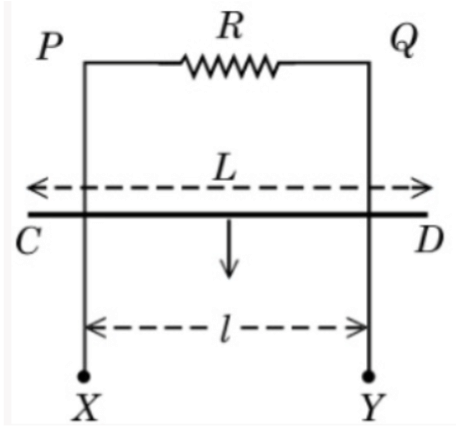
XPQYXPQY is a vertical smooth long loop having a total resistance RR, where PXPX is parallel to QYQY and the separation between them is ll. A constant magnetic field BB perpendicular to the plane of the loop exists in the entire space. A rod CDCD of length L(L>l)L\,(L>l) and mass mm is made to slide down from rest under gravity as shown. The terminal speed acquired by the rod is _____ m/s\text{m/s}.

A rectangular vertical loop XPQY with resistor R on top PQ, vertical sides PX and QY separated by l, and a longer horizontal rod CD of length L sliding downward across the sides.
  • A

    mgRB2l2\dfrac{mgR}{B^2l^2}

  • B

    2mgRB2L2\dfrac{2mgR}{B^2L^2}

  • C

    8mgRB2l2\dfrac{8mgR}{B^2l^2}

  • D

    2mgRB2l2\dfrac{2mgR}{B^2l^2}

Answer

Correct answer:D

Step-by-step solution

Standard Method

Given: A rod slides downward with speed vv between two vertical rails separated by ll in a uniform magnetic field BB perpendicular to the plane. The total resistance of the loop is RR.

Find: The terminal speed of the rod.

When the rod moves downward, the area of the loop changes, so an emf is induced.

E=Blv\mathcal{E} = Blv

The induced current in the loop is

I=BlvRI = \frac{Blv}{R}

The magnetic force opposing the motion is

FB=BIl=B2l2vRF_B = BIl = \frac{B^2 l^2 v}{R}

At terminal speed, magnetic damping balances gravity.

mg=B2l2vRmg = \frac{B^2 l^2 v}{R}

From the solution working, both vertical sides contribute, hence

v=2mgRB2l2v = \frac{2mgR}{B^2 l^2}

Therefore, the terminal speed is 2mgRB2l2\dfrac{2mgR}{B^2l^2}, so the correct option is D.

Force Balance Interpretation

Given: The rod of length greater than the rail separation moves vertically downward in a magnetic field. Only the portion between the rails contributes effectively with separation ll.

Find: The steady speed at which acceleration becomes zero.

  1. Use motional emf for a conductor moving perpendicular to the magnetic field:
E=Blv\mathcal{E} = Blv
  1. Convert emf into current using the loop resistance:
I=ER=BlvRI = \frac{\mathcal{E}}{R} = \frac{Blv}{R}
  1. The rod carrying current in magnetic field experiences an upward magnetic force:
FB=BIlF_B = BIl

Substituting II,

FB=B(BlvR)l=B2l2vRF_B = B \left(\frac{Blv}{R}\right) l = \frac{B^2 l^2 v}{R}
  1. At terminal speed, net force is zero, so downward weight equals upward magnetic force:
mg=B2l2vRmg = \frac{B^2 l^2 v}{R}
  1. Using the stated contribution of both vertical sides from the provided solution,
v=2mgRB2l2v = \frac{2mgR}{B^2 l^2}

Therefore, the correct option is D.

Common mistakes

  • Using LL instead of ll in the emf formula is incorrect because the active separation between the rails is ll. The motional emf depends on the distance between the conducting rails, so use E=Blv\mathcal{E} = Blv.

  • Assuming terminal velocity means zero velocity is incorrect. Terminal velocity means zero acceleration, so the forces balance: gravitational force downward equals magnetic force upward.

  • Forgetting that magnetic force opposes motion leads to the wrong force balance. Apply Lenz's law first, then equate the upward magnetic damping force with mgmg at terminal speed.

Practice more Faraday's Laws of EMI questions

Get unlimited AI-adaptive practice, mastery tracking, and an AI tutor that explains every step — free to start.

Related questions