MCQEasyJEE 2026Faraday's Laws of EMI

JEE Physics 2026 Question with Solution

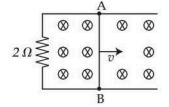
A 1m1 \, \text{m} long metal rod AB completes the circuit as shown in figure. The area of circuit is perpendicular to the magnetic field of 0.10T0.10 \, \text{T}. If the resistance of the total circuit is 2Ω2 \, \Omega then the force needed to move the rod towards right with constant speed (v)(v) of 1.5m/s1.5 \, \text{m/s} is _____ N\text{N}.

A rectangular conducting circuit with a 2 ohm resistor on the left side and a vertical sliding rod AB on the right moving right with speed v in a uniform magnetic field directed into the page.
  • A

    5.7×1025.7 \times 10^{-2}

  • B

    7.5×1037.5 \times 10^{-3}

  • C

    7.5×1027.5 \times 10^{-2}

  • D

    5.7×1035.7 \times 10^{-3}

Answer

Correct answer:B

Step-by-step solution

Standard Method

Given: rod length L=1mL = 1 \, \text{m}, magnetic field B=0.10TB = 0.10 \, \text{T}, total resistance R=2ΩR = 2 \, \Omega, speed v=1.5m/sv = 1.5 \, \text{m/s}.

Find: the external force required to move the rod with constant speed.

A conducting rod moving in a magnetic field produces motional emf, which drives current in the closed circuit. The current-carrying rod then experiences a magnetic force opposing the motion. For constant velocity, the applied force must balance this magnetic force.

Use:

E=BLv\mathcal{E} = BLv I=ERI = \frac{\mathcal{E}}{R} Fm=ILBF_m = ILB

Substitute the values:

E=(0.10)(1)(1.5)=0.15V\mathcal{E} = (0.10)(1)(1.5) = 0.15 \, \text{V} I=0.152=0.075AI = \frac{0.15}{2} = 0.075 \, \text{A} Fm=(0.075)(1)(0.10)=0.0075NF_m = (0.075)(1)(0.10) = 0.0075 \, \text{N}

For constant speed,

Fapp=Fm=0.0075N=7.5×10³NF_{\text{app}} = F_m = 0.0075 \, \text{N} = 7.5 \times 10^{-3} \, \text{N}

Therefore, the force needed is 7.5×10³N7.5 \times 10^{-3} \, \text{N}, so the correct option is B.

An alternative approach uses energy conservation:

Pmech=FappvP_{\text{mech}} = F_{\text{app}} v Pelec=I2R=E2R=(BLv)2RP_{\text{elec}} = I^2R = \frac{\mathcal{E}^2}{R} = \frac{(BLv)^2}{R}

Equating mechanical and electrical power,

Fappv=B2L2v2RF_{\text{app}} v = \frac{B^2L^2v^2}{R} Fapp=B2L2vRF_{\text{app}} = \frac{B^2L^2v}{R} Fapp=(0.10)2(1)2(1.5)2=7.5×10³NF_{\text{app}} = \frac{(0.10)^2(1)^2(1.5)}{2} = 7.5 \times 10^{-3} \, \text{N}

Common mistakes

  • Using F=BILF = BIL directly without first finding the induced current. The force depends on the current produced by the motional emf, so first calculate E=BLv\mathcal{E} = BLv and then I=ERI = \frac{\mathcal{E}}{R}.

  • Ignoring the total circuit resistance or using the rod resistance alone. The current is determined by the entire circuit resistance, so use R=2ΩR = 2 \, \Omega in I=ERI = \frac{\mathcal{E}}{R}.

  • Forgetting that constant speed means zero net force. The magnetic force opposes motion, so the applied external force must be equal in magnitude and opposite in direction to that magnetic force.

Practice more Faraday's Laws of EMI questions

Get unlimited AI-adaptive practice, mastery tracking, and an AI tutor that explains every step — free to start.

Related questions