
Match List-I with List-II.
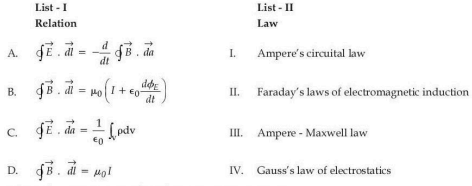
Choose the correct answer from the options given below :
- A
A-II, B-III, C-I, D-IV
- B
A-I, B-IV, C-III, D-II
- C
A-IV, B-I, C-II, D-III
- D
A-II, B-III, C-IV, D-I
Match List-I with List-II.
Choose the correct answer from the options given below :
A-II, B-III, C-I, D-IV
A-I, B-IV, C-III, D-II
A-IV, B-I, C-II, D-III
A-II, B-III, C-IV, D-I
Correct answer:D
Standard Method
Given: A matching question between equations in List-I and laws in List-II.
Find: The correct correspondence between the equations and the named laws.
From the solution text:
Therefore, the correct matching is A-II, B-III, C-IV, D-I.
The correct option is D.
Identify by the distinguishing term
Given: The equations in List-I are standard Maxwell-equation forms.
Find: The law name matched to each equation.
A quick identification method is to look for the special term in each equation:
Hence, A-II, B-III, C-IV, D-I, so the correct option is D.
Confusing Ampere's circuital law with Ampere-Maxwell law. This is wrong because the Maxwell-corrected form contains the displacement current term . Check whether that extra term is present before matching.
Mistaking Faraday's law for a Gauss-law relation. This is wrong because Faraday's law involves the line integral of electric field and the time rate of change of magnetic flux, whereas Gauss's law relates electric flux through a closed surface to enclosed charge.
Matching the electric-flux equation to the wrong law by focusing only on the symbol . This is wrong because the surface integral with enclosed charge over specifically identifies Gauss's law of electrostatics. Look at the full structure of the equation, not only the field symbol.
Get unlimited AI-adaptive practice, mastery tracking, and an AI tutor that explains every step — free to start.