
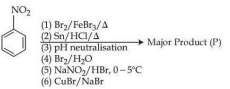
Consider the following sequence of reactions. The number of bromine atom(s) in the final product (P) will be :
- A
- B
- C
- D
Consider the following sequence of reactions. The number of bromine atom(s) in the final product (P) will be :
Correct answer:B
Standard Method
Given: A reaction sequence starts from nitrobenzene and asks for the number of bromine atoms in the final product P.
Find: The total number of bromine atoms present in the final product.
From the sequence shown, the key transformations are:
Nitrobenzene contains the group, which is meta-directing. Therefore, bromination introduces one bromine atom at the meta position, giving m-bromonitrobenzene.
Reduction with followed by neutralisation converts into , so the compound becomes m-bromoaniline.
Now is a strongly activating group. With bromine water, substitution occurs at all free ortho and para positions relative to . In m-bromoaniline, these are positions , , and . Hence, three more bromine atoms are introduced, forming 2,3,4,6-tetrabromoaniline.
Next, the amino group is diazotized and then replaced by bromine in the Sandmeyer reaction. This adds one more bromine atom at the position originally occupied by .
So, total bromine atoms in the final product are:
Therefore, the final product contains bromine atoms, so the correct option is B.
Stepwise Counting of Bromine Atoms
Given: The reaction sequence includes bromination, reduction, polybromination, diazotization, and Sandmeyer reaction.
Find: Count bromine atoms present in the final product after all steps.
Step 1: Nitrobenzene undergoes bromination. Since is meta-directing, the product is m-bromonitrobenzene.
Bromine count after this step:
Step 2: Reduction using changes to . No bromine atom is removed here.
Bromine count remains:
Step 3: Treatment with causes bromination at all available ortho and para positions of the aniline ring. For m-bromoaniline, the free activated positions are , , and .
Additional bromine atoms added:
Total bromine count now:
Step 4: Diazotization converts into a diazonium group.
Step 5: Sandmeyer reaction with replaces the diazonium group by bromine.
Additional bromine atoms added:
Final bromine count:
Hence, the final product is pentabromobenzene, and the correct option is B.
Assuming bromination of nitrobenzene occurs at the ortho or para position is incorrect because is a strong deactivating meta-directing group. First place the initial bromine at the meta position.
Counting only one additional bromine during reaction with bromine water is incorrect. In aniline derivatives, strongly activates the ring, so all free ortho and para positions must be checked for substitution.
Forgetting the final Sandmeyer replacement leads to an undercount. The diazonium group formed from is replaced by bromine, so one extra bromine atom must be added at the end.
Get unlimited AI-adaptive practice, mastery tracking, and an AI tutor that explains every step — free to start.