MCQEasyJEE 2026Electrophilic Substitution in Benzene

JEE Chemistry 2026 Question with Solution

Which of the following reaction is NOT correctly represented?
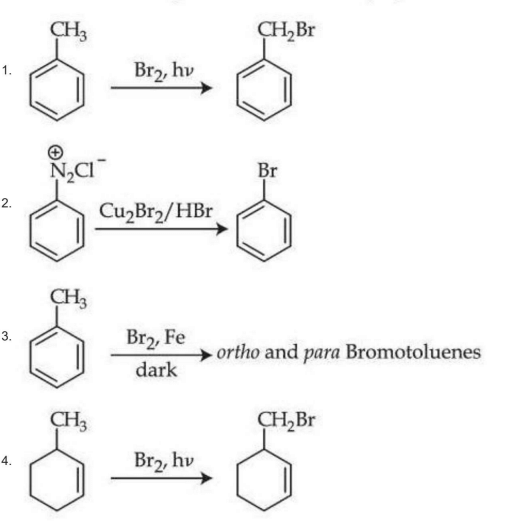
Four organic reaction schemes comparing bromination and diazonium substitution, with structures of methylbenzene, benzyl bromide, bromobenzene, bromotoluenes, and a cyclohexene-like substrate in option 4.
  • A

    Methylbenzene + Br2\mathrm{Br_2} hv\xrightarrow{hv} Benzyl bromide

  • B

    Benzene diazonium chloride + Cu2Br2/HBr\mathrm{Cu_2Br_2/HBr} \to Bromobenzene

  • C

    Methylbenzene + Br2/Fe\mathrm{Br_2/Fe} (dark) \to Ortho- and para-bromotoluenes

  • D

    Methylbenzene + Br2\mathrm{Br_2} hv\xrightarrow{hv} Benzyl bromide

Answer

Correct answer:D

Step-by-step solution

Standard Method

Given: Four represented reactions are shown for bromination and diazonium substitution.

Find: Which reaction is NOT correctly represented.

Step 1: Recall reaction types.

  • Free radical halogenation occurs at the benzylic position under light hvhv.
  • Electrophilic substitution occurs on the aromatic ring in the presence of Lewis acids such as Fe/FeCl3\mathrm{Fe/FeCl_3}.
  • Sandmeyer reaction converts diazonium salts into aryl halides using copper salts.

Step 2: Analyze each option.

  • A: Correct. Radical bromination of toluene at the benzylic position gives benzyl bromide.
  • B: Correct. Sandmeyer reaction gives bromobenzene.
  • C: Correct. Electrophilic substitution of toluene with Br2/Fe\mathrm{Br_2/Fe} in dark gives ortho- and para-bromotoluenes.
  • D: Incorrect. This is a repetition of option A, but shown as a separate option. The duplication makes it incorrectly represented in the given set.

Conclusion: Therefore, the correct option is D.

Reaction-Type Check

Given: The options test recognition of benzylic bromination, electrophilic aromatic substitution, and Sandmeyer reaction.

Find: The incorrectly represented reaction.

Use the reaction-condition check:

Light (hv)free radical substitution at benzylic positionBr2/Feelectrophilic substitution on aromatic ringDiazonium salt + Cu saltSandmeyer substitution\begin{aligned} \text{Light } (hv) &\Rightarrow \text{free radical substitution at benzylic position} \\ \mathrm{Br_2/Fe} &\Rightarrow \text{electrophilic substitution on aromatic ring} \\ \text{Diazonium salt + Cu salt} &\Rightarrow \text{Sandmeyer substitution} \end{aligned}

By this check, options A, B, and C match the expected chemistry. The solution states that D is the incorrectly represented entry because it is a duplicated representation of option A rather than a distinct correct reaction.

Therefore, the correct option is D.

Common mistakes

  • Confusing benzylic radical substitution with electrophilic aromatic substitution. Under hvhv, bromination occurs at the benzylic position, not on the ring. Use reaction conditions to decide the reaction type first.

  • Ignoring the role of Lewis acid such as Fe\mathrm{Fe} or FeCl3\mathrm{FeCl_3}. These conditions promote bromination on the aromatic ring, so option C should not be treated as benzylic bromination.

  • Missing the Sandmeyer reaction pattern. Diazonium salts with copper halide reagents form aryl halides, so option B is a standard conversion and should not be marked incorrect.

Practice more Electrophilic Substitution in Benzene questions

Get unlimited AI-adaptive practice, mastery tracking, and an AI tutor that explains every step — free to start.

Related questions