MCQMediumJEE 2026Electrophilic Substitution in Benzene

JEE Chemistry 2026 Question with Solution

Method used for separation of mixture of products (BB and CC) obtained in the following reaction is:
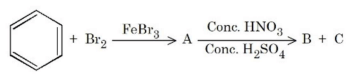
Reaction scheme showing benzene reacting with bromine in presence of FeBr3 to form A, followed by nitration with concentrated HNO3 and concentrated H2SO4 to give products B and C.
  • A

    Simple distillation

  • B

    Sublimation

  • C

    Fractional distillation

  • D

    Steam distillation

Answer

Correct answer:D

Step-by-step solution

Standard Method

Given: Benzene first reacts with Br2/FeBr3\mathrm{Br_2/FeBr_3} to form compound AA, and then AA undergoes nitration with concentrated HNO3/H2SO4\mathrm{HNO_3/H_2SO_4} to give products BB and CC.

Find: The method used for separation of the mixture of products BB and CC.

Concept: Electrophilic substitution reactions on benzene often give mixtures of positional isomers. The choice of separation technique depends on physical properties such as volatility, solubility in water, and difference in boiling points.

Step 1: Identify compound AA.

BenzeneBr2/FeBr3Bromobenzene (A)\text{Benzene} \xrightarrow{\mathrm{Br_2/FeBr_3}} \text{Bromobenzene } (A)

Step 2: Nitration of bromobenzene. Bromobenzene undergoes nitration with concentrated HNO3/H2SO4\mathrm{HNO_3/H_2SO_4}. Since bromine is an ortho-para directing group, nitration gives ortho-nitrobromobenzene (B)\text{(B)} and para-nitrobromobenzene (C)\text{(C)}.

Thus, BB and CC are positional isomers.

Step 3: Compare physical properties of BB and CC. Ortho-nitrobromobenzene is steam volatile, whereas para-nitrobromobenzene is less volatile due to better molecular packing and higher melting point.

This difference in volatility makes steam distillation an effective separation method.

Step 4: Eliminate other options.

  • Simple distillation: Boiling points are too close for efficient separation.
  • Fractional distillation: Not ideal here because the key difference is steam volatility.
  • Sublimation: Neither compound readily sublimes.

Therefore, the correct option is D and the separation method is Steam distillation.

Property-Based Elimination

Given: Products BB and CC are formed after bromination followed by nitration of benzene.

Find: Which separation method is suitable.

A bromine substituent directs nitration to the ortho and para positions, so BB and CC are ortho and para isomers. Ortho-substituted aromatic compounds are often steam volatile because of weaker intermolecular interactions, while the para isomer usually packs better in the crystal lattice and is less volatile.

So, instead of comparing only boiling points, focus on steam volatility. Therefore, the correct option is D, Steam distillation.

Common mistakes

  • Assuming that all positional isomers must be separated by fractional distillation. This is incorrect because the solution emphasizes difference in steam volatility, not merely a small difference in boiling points. Check the special physical property first.

  • Ignoring the ortho-para directing effect of bromine. This is wrong because identification of BB and CC as ortho- and para-nitrobromobenzene explains why their physical properties differ. First determine the actual products, then choose the separation method.

  • Choosing sublimation because one aromatic compound appears more rigid or more symmetric. This is incorrect because the solution states that neither product readily sublimes. Do not select sublimation unless the compound is known to sublime appreciably.

Practice more Electrophilic Substitution in Benzene questions

Get unlimited AI-adaptive practice, mastery tracking, and an AI tutor that explains every step — free to start.

Related questions