
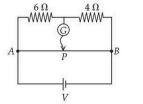
The total length of potentiometer wire AB is cm in the arrangement as shown in figure. If P is the point where the galvanometer shows zero reading then the length AP is _____ cm.
- A
- B
- C
- D
The total length of potentiometer wire AB is cm in the arrangement as shown in figure. If P is the point where the galvanometer shows zero reading then the length AP is _____ cm.
Correct answer:A
Standard Method
Given: The total length of potentiometer wire AB is cm. The resistors are and . The galvanometer shows zero reading at point P.
Find: The length AP.
At null deflection, the bridge is balanced. Therefore, the ratio of resistances equals the ratio of the lengths of the potentiometer wire segments.
Let cm. Then
Using and , we get
Cross-multiplying,
Therefore, the length AP is cm. The correct option is A.
Balance Condition Explanation
Given: The galvanometer shows zero reading at P.
Find: Why the wire length can be related to the resistor ratio.
When the galvanometer shows zero reading, the potential at point P is equal to the potential at the junction of the and resistors. This is the balanced Wheatstone bridge condition.
Since the potentiometer wire is uniform, resistance is directly proportional to length. Hence,
So the resistor ratio on the top branch must match the wire-segment ratio on the lower branch.
Thus,
with
Solving gives
Hence, the correct option is A.
Using without recognizing the standard bridge relation can confuse the setup. The correct relation is between resistor ratio and wire-length ratio: .
Forgetting that the potentiometer wire is uniform. The resistance of each segment is proportional to its length, so lengths can be compared through ratios only because the wire has uniform cross-section and material.
Taking as well. Since the total wire length is cm, once is chosen, the other segment must be .
Get unlimited AI-adaptive practice, mastery tracking, and an AI tutor that explains every step — free to start.