MCQMediumJEE 2026Wheatstone Bridge & Meter Bridge

JEE Physics 2026 Question with Solution

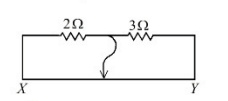
Two resistors 2Ω2\,\Omega and 3Ω3\,\Omega are connected in the gaps of a bridge as shown in the figure. The null point is obtained with the contact of jockey at some point on wire XYXY. When an unknown resistor is connected in parallel with 3Ω3\,\Omega resistor, the null point is shifted by 22.5cm22.5\,\text{cm} towards YY. The resistance of unknown resistor is _____ Ω\Omega.

A meter bridge wire from X to Y with two resistors of 2 ohm and 3 ohm in the two gaps above the wire, and a jockey contact connected to a point between them on the bridge wire.
  • A

    22

  • B

    33

  • C

    44

  • D

    11

Answer

Correct answer:A

Step-by-step solution

Standard Method

Given: The resistors in the two gaps are 2Ω2\,\Omega and 3Ω3\,\Omega. The initial null point is on wire XYXY. After connecting an unknown resistor in parallel with the 3Ω3\,\Omega resistor, the null point shifts by 22.5cm22.5\,\text{cm} towards YY.

Find: The value of the unknown resistance.

For a meter bridge at balance condition,

R1R2=l1l2\frac{R_1}{R_2} = \frac{l_1}{l_2}

Initial balance condition:

23=l100l\frac{2}{3} = \frac{l}{100-l}

Solving,

l=40cml = 40\,\text{cm}

New balance length after the shift: Since the null point shifts 22.5cm22.5\,\text{cm} towards YY,

l=40+22.5=62.5cml' = 40 + 22.5 = 62.5\,\text{cm}

Let the new effective resistance in the right gap be RR'. Then,

2R=62.537.5\frac{2}{R'} = \frac{62.5}{37.5}

So,

R=1.2ΩR' = 1.2\,\Omega

Now the unknown resistance XX is connected in parallel with 3Ω3\,\Omega, so

1R=13+1X\frac{1}{R'} = \frac{1}{3} + \frac{1}{X}

Substituting R=1.2ΩR' = 1.2\,\Omega,

11.2=13+1X\frac{1}{1.2} = \frac{1}{3} + \frac{1}{X}

Thus,

1X=5613=12\frac{1}{X} = \frac{5}{6} - \frac{1}{3} = \frac{1}{2}

Hence,

X=2ΩX = 2\,\Omega

Therefore, the resistance of the unknown resistor is 2Ω2\,\Omega. The correct option is A.

Balance Length Interpretation

Given: Initially the bridge balances with resistors 2Ω2\,\Omega and 3Ω3\,\Omega. Then the 3Ω3\,\Omega branch is replaced by its parallel combination with an unknown resistor.

Find: The unknown resistance.

Because the null point shifts towards YY, the balancing length measured from XX increases. That means the right-gap resistance has decreased, which is consistent with adding a resistor in parallel to 3Ω3\,\Omega.

Initially,

23=l100l\frac{2}{3} = \frac{l}{100-l}

which gives

l=40cml = 40\,\text{cm}

So the corresponding lengths are 40cm40\,\text{cm} and 60cm60\,\text{cm}.

After shifting,

l=62.5cml' = 62.5\,\text{cm}

and the other segment becomes

10062.5=37.5cm100 - 62.5 = 37.5\,\text{cm}

Hence the new ratio is

2R=62.537.5=53\frac{2}{R'} = \frac{62.5}{37.5} = \frac{5}{3}

Therefore,

R=2×35=1.2ΩR' = \frac{2\times 3}{5} = 1.2\,\Omega

Now use the parallel-combination relation:

R=3X3+XR' = \frac{3X}{3+X}

So,

1.2=3X3+X1.2 = \frac{3X}{3+X}

Then,

1.2(3+X)=3X1.2(3+X)=3X 3.6+1.2X=3X3.6+1.2X=3X 3.6=1.8X3.6=1.8X X=2ΩX=2\,\Omega

Therefore, the unknown resistor has value 2Ω2\,\Omega.

Common mistakes

  • Using the shifted length as 4022.540-22.5 instead of 40+22.540+22.5. Since the null point moves towards YY, the balancing length from XX increases. Always track from which end the length is measured.

  • Applying series-combination logic instead of parallel-combination logic for the unknown resistor with 3Ω3\,\Omega. A parallel connection reduces the effective resistance, so use 1R=13+1X\frac{1}{R'}=\frac{1}{3}+\frac{1}{X}.

  • Writing the meter bridge ratio in the wrong order, such as 32=l100l\frac{3}{2}=\frac{l}{100-l}. Keep the resistance ratio aligned with the corresponding wire-length ratio for the same sides of the bridge.

Practice more Wheatstone Bridge & Meter Bridge questions

Get unlimited AI-adaptive practice, mastery tracking, and an AI tutor that explains every step — free to start.

Related questions