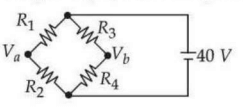
A Wheatstone bridge is initially at room temperature and all arms of the bridge have same value of resistances When resistance is heated, its resistance value increases by . The potential difference after is heated is ___ V.__
- A
- B
- C
- D
A Wheatstone bridge is initially at room temperature and all arms of the bridge have same value of resistances When resistance is heated, its resistance value increases by . The potential difference after is heated is ___ V.__

Correct answer:B
Standard Method
Given: All four arms of the Wheatstone bridge initially have equal resistance, so . After heating, . The supply voltage across the bridge is .
Find: The potential difference after is heated.
Concept: In a Wheatstone bridge, the potential difference between the midpoints is zero when the bridge is balanced:
Any change in one resistance unbalances the bridge, producing a potential difference between the midpoints.
Step 1: Initial condition Initially,
Hence, the bridge is balanced and:
Step 2: After heating
Step 3: Calculate potentials at midpoints using the voltage divider rule Potential at point :
Potential at point :
Step 4: Potential difference
Therefore, the potential difference is and the correct option is B.
Using the balance condition even after heating . This is wrong because increasing by unbalances the bridge. Instead, recalculate the midpoint potentials separately using the voltage divider rule.
Assuming the change in resistance makes the potential at change as well. This is wrong because the left branch still has equal resistors and , so remains half of the supply voltage. Evaluate each branch independently.
Taking the increased resistance as instead of . This is wrong because a increase means adding to . Use .
Get unlimited AI-adaptive practice, mastery tracking, and an AI tutor that explains every step — free to start.