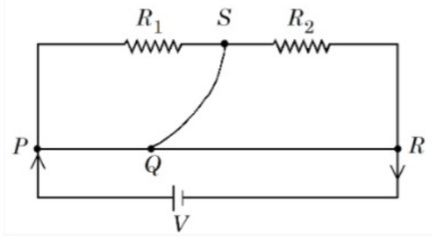
A meter bridge with two resistances and as shown in figure was balanced (null point) at from the point . The null point changed to from the point , when a resistance is connected in parallel to . The values of resistances and are
- A
- B
- C
- D
A meter bridge with two resistances and as shown in figure was balanced (null point) at from the point . The null point changed to from the point , when a resistance is connected in parallel to . The values of resistances and are

Correct answer:C
Standard Method
Given: A meter bridge is balanced at from point initially. After connecting in parallel with , the null point shifts to from .
Find: The values of and .
In a meter bridge at balance condition,
Step 1: Initial balance condition
For null point at ,
So,
Step 2: New balance condition after adding in parallel with
The equivalent resistance is
For the new null point at ,
Hence,
Step 3: Substitute
Now,
Therefore, the correct option is C and the resistances are and .
Using the meter bridge balance condition incorrectly as . This reverses the resistance ratio and gives wrong values. Use the same arm convention consistently: here .
Treating the added resistor as series combination with . It is connected in parallel, so the equivalent resistance must decrease. Use instead.
Using the new balance length incorrectly. At , the ratio is , so the two effective bridge arm resistances are equal. Do not substitute directly as a resistance value.
Get unlimited AI-adaptive practice, mastery tracking, and an AI tutor that explains every step — free to start.