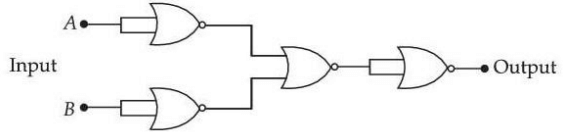
The given circuit works as:
- A
NOR gate
- B
OR gate
- C
AND gate
- D
NAND gate
The given circuit works as:

NOR gate
OR gate
AND gate
NAND gate
Correct answer:C
Standard Method
Given: A logic circuit with inputs and is shown.
Find: Which basic logic gate the circuit is equivalent to.
Each input first passes through a NOT operation, so the intermediate outputs are and .
These two signals are then applied to a NOR gate, so the output is
Using De Morgan's law,
Therefore, the circuit performs the operation of an AND gate.
The correct option is C.
Step-by-step Boolean Analysis
Given: The circuit contains inverter action on both inputs followed by a NOR combination.
Find: The equivalent logic gate.
Step 1: Trace the two inputs.
Step 2: Identify the final gate. The final combining gate is a NOR gate, so its output is
Step 3: Simplify the expression. Applying De Morgan's theorem,
Double inversion gives
Step 4: Interpret the result. The Boolean expression is the expression of an AND gate.
A truth-table check also confirms this:
So the output pattern is , which matches an AND gate.
Therefore, the given circuit is equivalent to AND gate, i.e. option C.
Mistake: Treating the middle gate expression as instead of . Why it is wrong: a NOR gate inverts the OR output. What to do instead: always include the output inversion bubble while writing the Boolean expression.
Mistake: Applying De Morgan's law incorrectly and concluding the circuit is a NAND gate. Why it is wrong: , not . What to do instead: substitute carefully and remove double complements step by step.
Mistake: Ignoring the initial NOT operations on inputs and . Why it is wrong: the intermediate signals entering the NOR gate are and , not and . What to do instead: trace the signal through each stage before identifying the final gate.
Get unlimited AI-adaptive practice, mastery tracking, and an AI tutor that explains every step — free to start.