
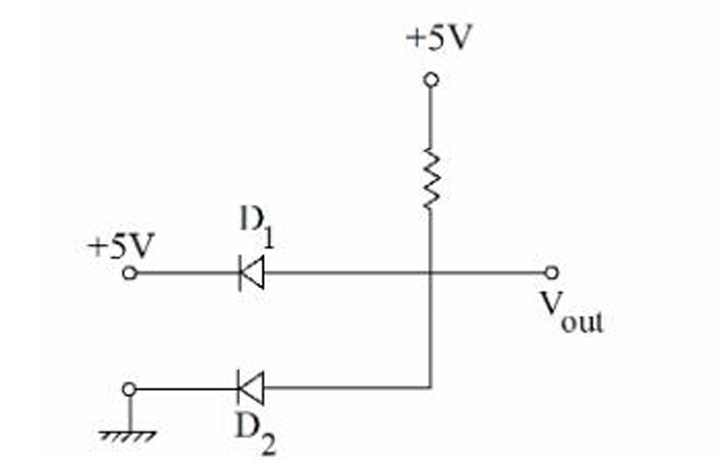
The output voltage in the following circuit is (Consider ideal diode case):
- A
- B
- C
- D
The output voltage in the following circuit is (Consider ideal diode case):
Correct answer:D
Standard Method
Given: The circuit contains ideal diodes and . Ideal diodes conduct when forward biased and do not conduct when reverse biased.
Find: The output voltage .
From the solution text, analyze the diode states:
Therefore, the output voltage is . The correct option is D.
The solution contains some inconsistent intermediate wording mentioning , but its final conclusion explicitly states that the output voltage is , and the listed correct option is D.
Using the diode-bias argument from the hint
Given: For ideal diodes, a forward-biased diode has zero voltage drop and a reverse-biased diode behaves like an open circuit.
Find: The value of .
Use the hint from the solution: the conducting diode pulls the output voltage to .
So, the node at is clamped to ground potential, while the other diode remains non-conducting.
Hence, the output voltage is and the correct option is D.
Assuming both diodes conduct simultaneously. That is wrong because ideal diode conduction depends on biasing. First determine which diode is forward biased and which is reverse biased, then find the node voltage.
Taking the resistor connection to as sufficient to force . This is wrong because a conducting ideal diode can clamp the node. Always check whether the node is being held at ground or supply through an ideal diode.
Ignoring the final conclusion of the solution and focusing only on an inconsistent intermediate sentence. When the working text has a contradiction, use the explicit final conclusion and stated correct option to identify the answer.
Get unlimited AI-adaptive practice, mastery tracking, and an AI tutor that explains every step — free to start.