
Which among the following compounds give yellow solid when reacted with NaOI/NaOH?
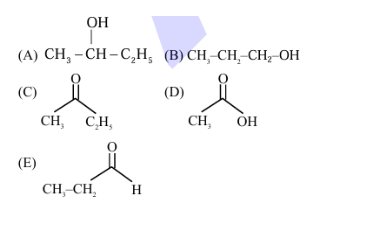
Choose the correct answer from the options given below:
- A
(B), (C) and (E) Only
- B
(A) and (C) Only
- C
(C) and (D) Only
- D
(A), (C) and (D) Only
Which among the following compounds give yellow solid when reacted with NaOI/NaOH?
Choose the correct answer from the options given below:
(B), (C) and (E) Only
(A) and (C) Only
(C) and (D) Only
(A), (C) and (D) Only
Correct answer:B
Standard Method
Given: We must identify which compounds give a yellow solid with NaOI/NaOH.
Find: Which labeled compounds undergo the iodoform reaction and hence form yellow .
This is the haloform reaction. A yellow precipitate is formed by compounds containing the methyl ketone group , or by alcohols of the type because they are oxidized to methyl ketones under these conditions.
From the given structures:
Therefore, the compounds that give yellow solid are (A) and (C) only. Hence, the correct option is B.
Using the iodoform criterion
Given: NaOI/NaOH gives a yellow solid in the iodoform test.
Find: Which of (A) to (E) satisfy the structural requirement.
The required structural conditions are:
Checking each compound one by one:
Thus only (A) and (C) form the yellow precipitate of iodoform. The correct option is B.
The second provided approach contains inconsistent structural descriptions, but the conclusion supported by the valid structural analysis is B.
Assuming every alcohol gives the yellow precipitate is incorrect. Only alcohols of type are oxidized to methyl ketones. Check the carbon bearing before concluding.
Treating any carbonyl compound as positive for the test is wrong. The compound must be a methyl ketone , not just any aldehyde or carboxylic acid.
Marking propanal (E) as positive is a common error. In the aldehydes, essentially only ethanal gives the iodoform reaction; does not. Use the specific structural criterion instead of guessing from functional group name alone.
Get unlimited AI-adaptive practice, mastery tracking, and an AI tutor that explains every step — free to start.