
Which of the following curves possibly represent one-dimensional motion of a particle?
- A
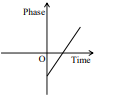
- B
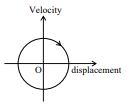
- C
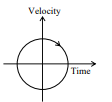
- D
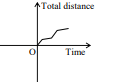
Which of the following curves possibly represent one-dimensional motion of a particle?
Correct answer:A
Standard Method
Given: Four different curves are shown.
Find: Which curves can possibly represent one-dimensional motion of a particle, and hence the correct option.
To test whether a graph can represent physical motion, check whether the plotted quantity is physically consistent with one-dimensional kinematics.
For curve (A), phase versus time is a straight line. In SHM, phase is
So a linear phase-time graph is physically possible. Hence (A) is possible.
For curve (B), velocity versus displacement is a closed curve. In SHM,
This is an ellipse, and with suitable scaling it can appear as a circle. Therefore (B) is also possible.
For curve (C), velocity versus time is a circle. A vertical line at a given time cuts the curve at two points, implying two different velocities at the same instant. That is physically impossible. Hence (C) is not possible.
For curve (D), total distance versus time increases, then remains constant, then increases again. Total distance is always non-decreasing, and a flat portion means the particle is at rest for some time. Hence (D) is possible.
Therefore, the possible curves are (A), (B), and (D) only.
Among the given combinations, this corresponds to option (1). The correct option is A.
Quick Graph Validity Check
Given: Four graphs representing different physical quantities.
Find: Which ones can represent one-dimensional motion.
Use a quick screening rule:
Applying this:
So the correct set is A, B and D only, which corresponds to option A.
Students often reject the versus closed curve in (B) because one displacement corresponds to two velocities. This is not wrong: at the same displacement, the particle may move in opposite directions at different instants. The uniqueness requirement applies to a quantity versus time, not necessarily versus another variable like displacement.
A common mistake is to accept (C) as valid by treating it like a phase-space curve. This is wrong because the horizontal axis is time, so each instant must correspond to exactly one velocity. Use the vertical line test for graphs against time.
Some students think total distance in (D) must always increase strictly. This is incorrect because the particle may remain at rest for some interval, making the graph horizontal. The correct condition is that total distance must be non-decreasing, not necessarily strictly increasing.
Get unlimited AI-adaptive practice, mastery tracking, and an AI tutor that explains every step — free to start.