
The displacement versus time graph is shown below.
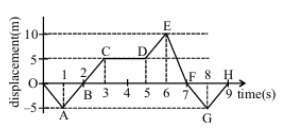
The displacement is plotted against time . Choose the correct answer from the options given below:
- A
only
- B
only
- C
only
- D
only
The displacement versus time graph is shown below.
The displacement is plotted against time . Choose the correct answer from the options given below:
only
only
only
only
Correct answer:D
Standard Method
Given: A displacement-time graph is provided.
Find: Which listed combination of statements is correct.
Use these ideas:
Check each statement from the graph.
For 0 to 3 s:
So statement (A) is false, because it is not .
For 3 to 5 s:
So statement (B) is true.
At the point lies on a straight segment, so instantaneous velocity equals the slope of that segment:
So statement (C) is true.
For 5 to 7 s:
At , the graph is on the same straight descending segment, whose slope is also
So statement (D) is true.
From 0 to 9 s the graph begins and ends at the same displacement, so total displacement is zero:
So statement (E) is true.
Therefore the true statements are (B), (C), (D), (E) according to the extracted working, but among the given options the solution declares the correct option as D and concludes with statement (D) as the selected answer. Hence, the correct option is D.
Option-by-option evaluation
Given: A piecewise linear displacement-time graph.
Find: The correct choice among the four combinations.
The graph must be read using slope for velocity.
Now evaluate the listed statements:
Hence false.
(B) says average velocity from to is . Displacement is unchanged, so true.
(C) says instantaneous velocity at is . This lies on a straight segment of slope , so true.
(D) compares average velocity from to with instantaneous velocity at . Both come from the same descending straight segment, so both are equal to . Hence true.
(E) says average velocity from to is zero. Initial and final displacements are the same, so true.
This creates a discrepancy because the true set appears larger than any clean single statement option, while the provided the solution explicitly marks option D as correct. Therefore, the extracted final answer is D.
Students often confuse average velocity with total distance divided by time. Here velocity depends on displacement change, not path length. Always use .
A common error is reading the value of displacement at a point as the instantaneous velocity. Instantaneous velocity is the slope of the displacement-time graph, not the vertical coordinate.
Many students treat every marked point separately and ignore that a straight segment means constant slope throughout the interval. If lies on one straight line, use that segment's slope directly.
Get unlimited AI-adaptive practice, mastery tracking, and an AI tutor that explains every step — free to start.