MCQEasyJEE 2025Graphs of Motion

JEE Physics 2025 Question with Solution

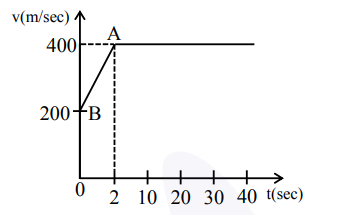
The motion of an airplane is represented by the velocity-time graph as shown below. The distance covered by the airplane in the first 30.5s30.5 \, \text{s} is _____ km\text{km}.

Velocity-time graph for an airplane showing velocity increasing linearly from 200 m/s at 0 s to 400 m/s at 2 s, then remaining constant at 400 m/s up to 40 s, with point A at 2 s and 400 m/s.
  • A

    99

  • B

    66

  • C

    33

  • D

    1212

Answer

Correct answer:D

Step-by-step solution

Standard Method

Given: The distance is to be found from the velocity-time graph for the first 30.5s30.5 \, \text{s}.

Find: Total distance covered in 30.5s30.5 \, \text{s}.

The area under a velocity-time graph gives the distance travelled.

From the graph, the motion has two parts:

  1. From 00 to 2s2 \, \text{s}, velocity increases linearly from 200m/s200 \, \text{m/s} to 400m/s400 \, \text{m/s}.
  2. From 2s2 \, \text{s} to 30.5s30.5 \, \text{s}, velocity remains constant at 400m/s400 \, \text{m/s}.

Distance in the first part:

d1=(200+4002)×2=600md_1 = \left(\frac{200 + 400}{2}\right) \times 2 = 600 \, \text{m}

Distance in the second part:

d2=400×(30.52)=400×28.5=11400md_2 = 400 \times (30.5 - 2) = 400 \times 28.5 = 11400 \, \text{m}

Total distance:

d=d1+d2=600+11400=12000md = d_1 + d_2 = 600 + 11400 = 12000 \, \text{m}

Converting into kilometres:

d=120001000=12kmd = \frac{12000}{1000} = 12 \, \text{km}

Therefore, the airplane covers 12km12 \, \text{km} in the first 30.5s30.5 \, \text{s}. The correct option is D.

Area Under the Graph

Given: A velocity-time graph with velocity changing from 200m/s200 \, \text{m/s} to 400m/s400 \, \text{m/s} in the first 2s2 \, \text{s}, and then staying at 400m/s400 \, \text{m/s} up to 30.5s30.5 \, \text{s}.

Find: Distance covered in the first 30.5s30.5 \, \text{s}.

This graph can be treated as a trapezium from 00 to 2s2 \, \text{s} and a rectangle from 22 to 30.5s30.5 \, \text{s}.

For 00 to 2s2 \, \text{s}:

d1=(vi+vf2)td_1 = \left(\frac{v_i + v_f}{2}\right) t d1=(200+4002)×2=600md_1 = \left(\frac{200 + 400}{2}\right) \times 2 = 600 \, \text{m}

For 22 to 30.5s30.5 \, \text{s}:

d2=vt=400×28.5=11400md_2 = vt = 400 \times 28.5 = 11400 \, \text{m}

Hence,

d=600+11400=12000m=12kmd = 600 + 11400 = 12000 \, \text{m} = 12 \, \text{km}

The final answer is 12km12 \, \text{km}, so the correct option is D.

The other solution path on the page gives 11.8km11.8 \, \text{km} by incorrectly taking the first segment as a triangle from zero velocity. The graph actually starts at 200m/s200 \, \text{m/s}, so the correct first area is a trapezium, not a triangle.

Common mistakes

  • Treating the first 00 to 2s2 \, \text{s} region as a triangle from zero velocity is incorrect because the graph starts at 200m/s200 \, \text{m/s}, not 00. Use the area of a trapezium or average velocity instead.

  • Using only 30.5s30.5 \, \text{s} as the constant-velocity interval is wrong because the airplane reaches 400m/s400 \, \text{m/s} after 2s2 \, \text{s}. The constant-velocity time is 30.52=28.5s30.5 - 2 = 28.5 \, \text{s}.

  • Forgetting to convert meters to kilometers leads to an incorrect final numerical answer. After finding 12000m12000 \, \text{m}, divide by 10001000 to get 12km12 \, \text{km}.

Practice more Graphs of Motion questions

Get unlimited AI-adaptive practice, mastery tracking, and an AI tutor that explains every step — free to start.

Related questions