MCQMediumJEE 2025Internal Energy & Enthalpy

JEE Chemistry 2025 Question with Solution

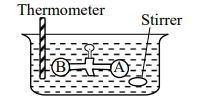
Two vessels A and B are connected via stopcock. Vessel A is filled with a gas at a certain pressure. The entire assembly is immersed in water and allowed to come to thermal equilibrium with water. After opening the stopcock the gas from vessel A expands into vessel B and no change in temperature is observed in the thermometer. Which of the following statement is true?

Two connected vessels A and B immersed in a water bath, with a thermometer on the left and a stirrer on the right, showing the apparatus used for gas expansion through a stopcock.
  • A

    dw=0dw = 0

  • B

    dq=0dq = 0

  • C

    du=0du = 0

  • D

    The pressure in the vessel B before opening the stopcock is zero

Answer

Correct answer:D

Step-by-step solution

Standard Method

Given: Gas in vessel A expands into vessel B after opening the stopcock, and no temperature change is observed.

Find: Which statement is certainly true.

This setup represents free expansion only when vessel B is initially a vacuum. In free expansion, the gas expands against zero external pressure.

Using the work relation,

dw=PextdVdw = -P_{\text{ext}} dV

for free expansion,

Pext=0P_{\text{ext}} = 0

therefore,

dw=0dw = 0

However, whether dq=0dq = 0 and du=0du = 0 are always true depends on the nature of the gas and the interpretation of the process. The solution discussion states that these conclusions can be conditional, whereas the condition for free expansion itself is unambiguous.

So the universally correct statement is that vessel B must have been empty before opening the stopcock, i.e. its pressure was zero.

Therefore, the correct option is D.

Detailed Explanation

Given: The gas initially occupies vessel A. After the stopcock is opened, it expands into vessel B while the assembly is in a water bath, and no change in temperature is observed.

Find: The true statement among the four options.

Step 1: Identify the process

The described process is a free expansion. For a gas to expand freely, the region into which it expands must offer no opposing pressure. Therefore vessel B must be evacuated.

That means the pressure in vessel B before opening the stopcock is

PB=0P_B = 0

Step 2: Check the work term

For expansion work,

dw=PextdVdw = -P_{\text{ext}} dV

Since the gas expands into vacuum,

Pext=0P_{\text{ext}} = 0

so,

dw=0dw = 0

Step 3: Check heat and internal energy statements

The thermometer shows no temperature change, but the solution notes that the conclusions about dqdq and dudu can depend on whether the gas is treated as ideal or real. Hence these are not taken as the most universally valid statements here.

Step 4: Conclude

The defining condition of the process is that vessel B was initially vacuum. Therefore, the pressure in vessel B before opening the stopcock is zero.

Hence, the correct option is D.

Common mistakes

  • Assuming that 'no temperature change' alone is sufficient to conclude every thermodynamic quantity is zero. This is incorrect because zero temperature change does not automatically fix dqdq or dudu for all gases. First identify the process and the gas model.

  • Forgetting that free expansion means expansion against zero external pressure. If vessel B had non-zero pressure, the gas would have to push against it, so it would not be a free expansion.

  • Choosing dq=0dq = 0 or du=0du = 0 without checking whether the statement is universally true. In this question, the safest and defining conclusion comes from the physical setup: vessel B must initially be vacuum.

Practice more Internal Energy & Enthalpy questions

Get unlimited AI-adaptive practice, mastery tracking, and an AI tutor that explains every step — free to start.

Related questions