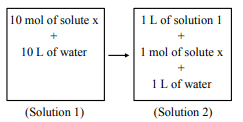
Which of the following properties will change when system containing solution 1 will become solution 2 ?
- A
Molar heat capacity
- B
Density
- C
Concentration
- D
Gibbs free energy
Which of the following properties will change when system containing solution 1 will become solution 2 ?

Molar heat capacity
Density
Concentration
Gibbs free energy
Correct answer:D
Standard Method
Given: The system changes from solution 1 to solution 2. Both solutions have the same composition, namely mole of in of .
Find: Which property changes during this transition.
Use the distinction between intensive and extensive properties.
Since both solutions have the same composition, intensive properties such as molar heat capacity, density, and concentration remain the same.
However, the total amount of the system is different in solution 1 and solution 2. Therefore, an extensive thermodynamic property will change.
Gibbs free energy is an extensive property, so it will be different for the two systems.
Therefore, the correct option is D.
Detailed Explanation
Given: Solution 1 contains a larger total amount than solution 2, but both have the same composition.
Find: The property that changes when moving from solution 1 to solution 2.
Approach the options one by one:
Because the concentration is unchanged but the total amount is different, the extensive property Gibbs free energy changes.
Hence, the correct answer is D.
Treating Gibbs free energy as an intensive property is incorrect because total depends on the amount of substance. Check whether the property scales with system size before deciding.
Assuming concentration changes just because the total quantity changes is wrong. If the ratio of solute to solvent remains the same, concentration remains unchanged.
Confusing molar heat capacity with total heat capacity leads to error. The molar quantity is intensive, whereas total heat capacity is extensive.
Get unlimited AI-adaptive practice, mastery tracking, and an AI tutor that explains every step — free to start.