
Match the LIST-I with LIST-II.
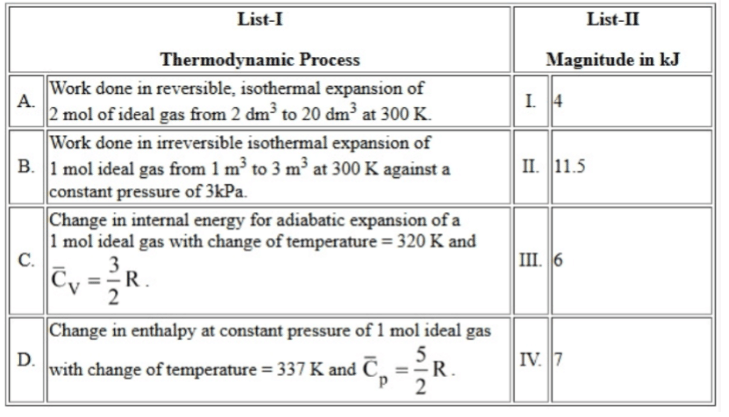
Choose the correct answer from the options given below:
- A
A-III, B-II, C-IV, D-I
- B
A-II, B-I, C-III, D-IV
- C
A-I, B-II, C-III, D-IV
- D
A-II, B-III, C-I, D-IV
Match the LIST-I with LIST-II.
Choose the correct answer from the options given below:
A-III, B-II, C-IV, D-I
A-II, B-I, C-III, D-IV
A-I, B-II, C-III, D-IV
A-II, B-III, C-I, D-IV
Correct answer:B
Standard Method
Given: A matching question on thermodynamic processes and their magnitudes in .
Find: The correct correspondence between A, B, C, D and I, II, III, IV.
For A: reversible isothermal expansion of mol ideal gas from to at .
Thus, A II.
For B: irreversible isothermal expansion against constant external pressure.
Thus, B I.
For C: change in internal energy.
Thus, C III.
For D: change in enthalpy at constant pressure.
Thus, D IV.
So the final matching is
Therefore, the correct option is B.
Process-wise Identification
Given: Each item in List-I asks for either work, internal energy change, or enthalpy change.
Find: Which magnitude in List-II matches each process.
Applying these:
Hence the correct sequence is A-II, B-I, C-III, D-IV, which corresponds to Option B.
Using the irreversible work formula for the reversible isothermal process in A is incorrect because reversible isothermal work depends on the logarithmic volume ratio. Use for A instead.
Assuming for process C is wrong because that result applies to an isothermal ideal-gas process, not to the adiabatic case with a stated temperature change. Here you must use .
Confusing and leads to interchanging C and D. Internal energy change uses , while enthalpy change at constant pressure uses .
Get unlimited AI-adaptive practice, mastery tracking, and an AI tutor that explains every step — free to start.