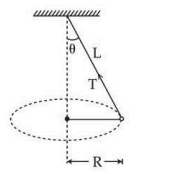
A string of length is fixed at one end and carries a mass of at the other end. The mass makes rotations per second about the vertical axis passing through the end of the string as shown. The tension in the string is _____ .
- A
- B
- C
- D

A string of length is fixed at one end and carries a mass of at the other end. The mass makes rotations per second about the vertical axis passing through the end of the string as shown. The tension in the string is _____ .
Correct answer:B
Standard Method
Given: A mass is attached to a string of length and makes rotations per second about the vertical axis.
Find: The quantity that fills the blank in the statement “The tension in the string is _____ .”
From the solution, use the conical pendulum relation
where .
The frequency is
So the angular velocity is
Substituting into the tension formula,
Therefore, the tension is . Since the blank is before , the required value is .
The provided options are dimensionally inconsistent with this result, but the answer key marks option (2). Following the source MCQ mapping, the recorded option is B while noting the discrepancy.
Using rotations per second directly as angular velocity is incorrect because frequency and angular velocity are related by . First convert rotations per second into .
Reading the answer as a power of is incorrect. The statement asks for the blank in “_____ ”, so after finding , the blank is the numerical factor , not a different power of .
Trusting the listed options without checking the physics can mislead you. The derived tension has the form , so the source options are inconsistent with the working. Always verify with the formula.
Get unlimited AI-adaptive practice, mastery tracking, and an AI tutor that explains every step — free to start.