
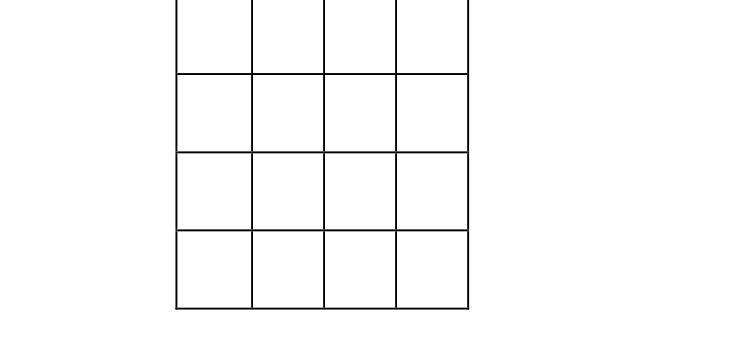
A board has squares as shown in the figure. Out of these squares, two squares are chosen at random. The probability that they have no side in common is:
- A
- B
- C
- D
A board has squares as shown in the figure. Out of these squares, two squares are chosen at random. The probability that they have no side in common is:
Correct answer:A
Standard Method
Given: A board has squares arranged in a grid. Two squares are chosen at random.
Find: The probability that the chosen squares have no side in common.
Total number of ways to choose any two squares is
Now count the pairs that share a side.
In each row of squares, the number of adjacent horizontal pairs is . Since there are rows, the number of horizontal adjacent pairs is
Similarly, in each column of squares, the number of adjacent vertical pairs is . Since there are columns, the number of vertical adjacent pairs is
So, total pairs sharing a side are
Hence, the number of pairs having no side in common is
Therefore, the required probability is
So, the correct option is A.
Using complementary counting
Given: Two squares are selected from a grid.
Find: The probability that the two selected squares do not share a side.
Instead of counting all valid pairs directly, first count all possible pairs and then subtract the pairs that are adjacent.
All possible pairs:
Adjacent pairs occur only in two ways:
For horizontal adjacency, each of the rows contributes adjacent pairs:
For vertical adjacency, each of the columns contributes adjacent pairs:
Thus, total adjacent pairs are
So the favorable pairs are
Hence,
Therefore, the probability that the two chosen squares have no side in common is .
Counting diagonal-touching squares as sharing a side is incorrect because sharing only a corner does not mean sharing a side. Count only horizontal and vertical adjacent pairs.
Using the favorable count as is wrong because the adjacent pairs are , so the non-adjacent pairs must be , not .
Forgetting to count both horizontal and vertical adjacent pairs gives an incomplete total. Compute adjacency in rows and columns separately, then add them.
Get unlimited AI-adaptive practice, mastery tracking, and an AI tutor that explains every step — free to start.