
A network of four resistances is connected to a battery, as shown in the figure. The magnitude of voltage difference between the points A and B is required.
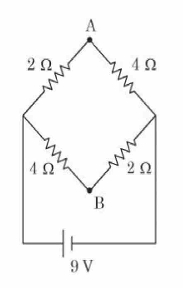
A network of four resistances is connected to a battery, as shown in the figure. The magnitude of voltage difference between the points A and B is required.
Correct answer:3
Standard Method
Given: A resistor network is connected to a battery. The resistances are , , , and . Find: The magnitude of potential difference between points A and B.
The two paths between the battery terminals act as two series branches in parallel.
Left branch resistance:
Right branch resistance:
Since these two equal branches are in parallel, the equivalent resistance is
Hence the total current supplied by the battery is
Because both parallel branches have equal resistance, the current divides equally:
Potential drop from the battery terminal to point A through the resistor is
Potential drop from the battery terminal to point B through the resistor is
Therefore,
So, the required magnitude of voltage difference is .
Symmetry Check
Given: The two opposite series branches are and . Find: The voltage difference between A and B.
Both branches have the same total resistance:
So the branch currents are equal. With equal current in each branch, the potential drops are proportional to the resistances encountered from the same battery side.
At A, the drop is across :
At B, the drop is across :
Thus,
Therefore, the answer is .
Assuming the network is a balanced Wheatstone bridge and concluding that the potential difference between A and B is zero is incorrect. The ratios and are not equal, so the bridge is not balanced. First compare the arm ratios before using the balanced-bridge result.
Using the total current directly in each resistor is wrong because the two branches are in parallel. The total current splits equally, so each branch carries . Always divide current correctly in parallel branches.
Calculating the potential at A and B from different reference terminals can produce the wrong sign or wrong magnitude. Measure both potentials from the same battery terminal, then take to get the magnitude of the required voltage difference.
Get unlimited AI-adaptive practice, mastery tracking, and an AI tutor that explains every step — free to start.