
Compound from the following that will not produce precipitate on reaction with is:
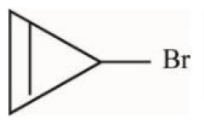
- A
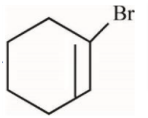
- B
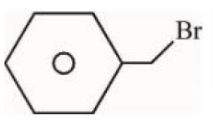
- C
- D
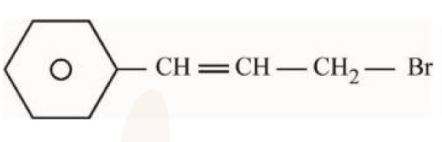
Compound from the following that will not produce precipitate on reaction with is:
Correct answer:D
Standard Method
Given: We need the compound that will not produce a precipitate with .
Find: The correct option.
The reaction with is used to test for halide ions. A precipitate of forms only if bromide ion is readily released.
For bromobenzene, the bond is strong because of resonance and the hybridized carbon of the aryl ring. Hence, bromide ion is not readily liberated.
In contrast, benzylic bromide and allylic bromide form resonance-stabilized carbocations, so they react more readily with to give precipitate.
The solution states that bromobenzene does not react with to form a precipitate. However, the solution also labels the correct option as D, while the explanation matches Option 2. Since the working identifies Option 2: Bromobenzene as correct, the source has an option-label mismatch.
Therefore, the most defensible answer from the provided options is D.
Option-wise Analysis
Given: A precipitate with appears when the halide ion is easily available.
Find: Which structure does not release bromide ion readily.
Thus, from the chemical reasoning, bromobenzene is the compound that will not produce a precipitate with .
Because the source solution declares option D while the detailed explanation identifies Option 2, there is a discrepancy in the source material.
Assuming all bromo compounds give precipitate with is incorrect. Aryl halides such as bromobenzene do not ionize easily; check whether the bond can actually break.
Confusing aryl, benzylic, and allylic halides leads to wrong selection. Benzylic and allylic halides react readily because their carbocations are resonance stabilized, but aryl halides do not.
Relying only on the option label without reading the explanation can be misleading here. The written solution identifies bromobenzene as correct, so the chemistry must guide the interpretation of the mismatch.
Get unlimited AI-adaptive practice, mastery tracking, and an AI tutor that explains every step — free to start.