MCQMediumJEE 2025Aryl Halides

JEE Chemistry 2025 Question with Solution

Identify the products [A] and [B] respectively in the following reaction: C6H5ClNaOH,623K,300atm[A]Na2Cr2O7[B]H+C_6H_5Cl \xrightarrow{NaOH, 623K, 300 atm} [A] \xrightarrow{Na_2Cr_2O_7} [B] \xrightarrow{H^+}
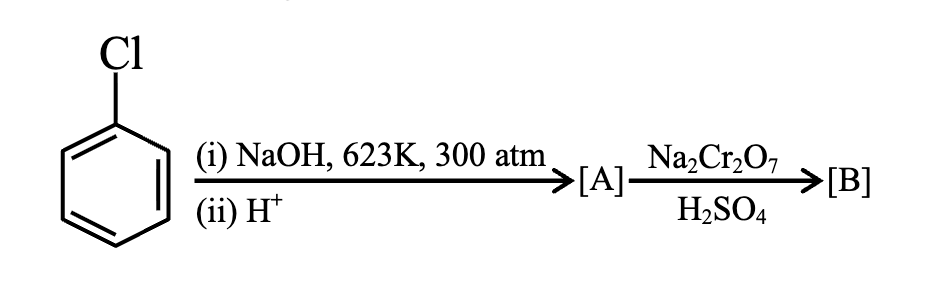
Reaction scheme and four structural options showing chlorobenzene conversion under sodium hydroxide at 623 K and 300 atm, followed by sodium dichromate in sulfuric acid, with candidate structures for products A and B.
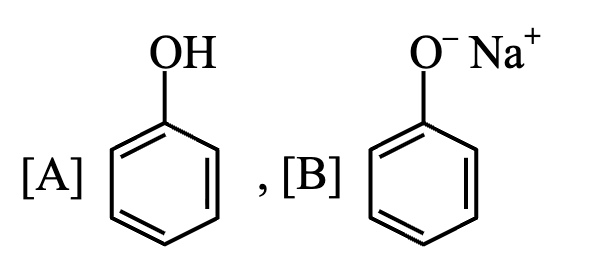
  • A
    Option 1 shows A as phenol and B as sodium phenoxide with aromatic ring structures and attached OH or O minus Na plus groups.
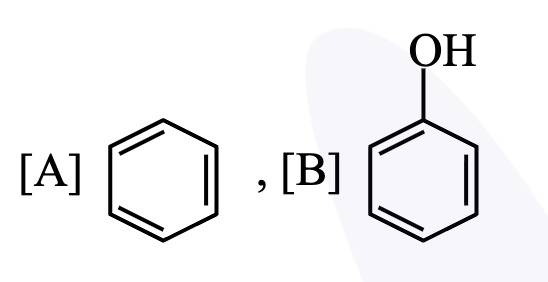
  • B
    Option 2 shows A as benzene and B as phenol with aromatic ring structures, one unsubstituted and one bearing an OH group.
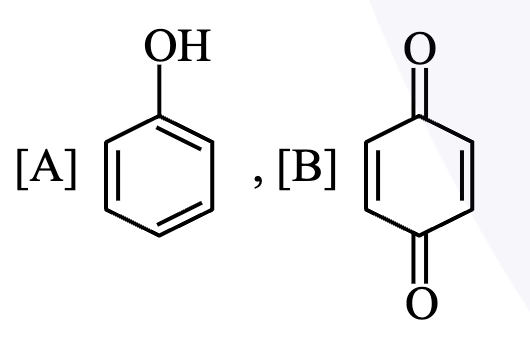
  • C
    Option 3 shows A as phenol and B as para benzoquinone with one aromatic ring bearing OH and another ring bearing two carbonyl groups.
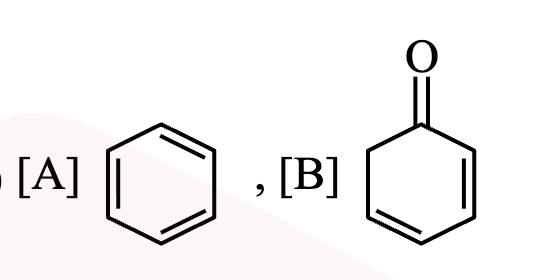
  • D
    Option 4 shows A as benzene and B as cyclohexadienone like structure with one carbonyl group on a six membered ring.

Answer

Correct answer:C

Step-by-step solution

Standard Method

Given: Chlorobenzene reacts with NaOH\text{NaOH} at 623K623 \, \text{K} and 300atm300 \, \text{atm}, then the product is oxidized using Na2Cr2O7/H2SO4\text{Na}_2\text{Cr}_2\text{O}_7/\text{H}_2\text{SO}_4.

Find: The identities of [A] and [B].

Under Dow process conditions, chlorobenzene undergoes nucleophilic substitution to form phenol after acidification.

C6H5Cl300atmNaOH,623KC6H5ONaH+C6H5OHC_6H_5Cl \xrightarrow[300\,\text{atm}]{NaOH,\,623\,\text{K}} C_6H_5ONa \xrightarrow{H^+} C_6H_5OH

So, [A] is phenol.

Phenol on oxidation with sodium dichromate in acidic medium gives benzoquinone.

C6H5OHNa2Cr2O7/H2SO4benzoquinoneC_6H_5OH \xrightarrow{\text{Na}_2\text{Cr}_2\text{O}_7/\text{H}_2\text{SO}_4} \text{benzoquinone}

Hence, [B] is benzoquinone.

Therefore, the correct option is C.

Step-by-step Identification

Given: The sequence starts from chlorobenzene.

Find: Which structures correspond to [A] and [B].

  1. The first reagent set, NaOH\text{NaOH} at 623K623 \, \text{K} and 300atm300 \, \text{atm}, is characteristic of conversion of chlorobenzene into phenol through sodium phenoxide as an intermediate.
  2. After acidification, the isolated product is phenol, so [A] = phenol.
  3. The next reagent, Na2Cr2O7\text{Na}_2\text{Cr}_2\text{O}_7 in acidic medium, oxidizes phenol to benzoquinone.
  4. Therefore [B] = benzoquinone.

This matches the structure shown in option C.

There is a discrepancy with the answer key text provided separately, but the extracted solution working and the structural option image both support phenol and benzoquinone. Hence the defensible answer is C.

Common mistakes

  • Assuming [A] is directly sodium phenoxide. That is incomplete because the reaction sequence shown includes H+H^+, which converts sodium phenoxide to phenol. Always account for the acidification step before identifying the final intermediate.

  • Treating oxidation of phenol with Na2Cr2O7/H2SO4\text{Na}_2\text{Cr}_2\text{O}_7/\text{H}_2\text{SO}_4 as formation of benzoic acid. That is incorrect here because the standard oxidation product in this context is benzoquinone, not ring cleavage to benzoic acid.

  • Ignoring the reaction conditions 623K623 \, \text{K} and 300atm300 \, \text{atm}. These harsh conditions are a key clue for the Dow process conversion of chlorobenzene to phenol. Without using this clue, the first step is often misidentified.

Practice more Aryl Halides questions

Get unlimited AI-adaptive practice, mastery tracking, and an AI tutor that explains every step — free to start.

Related questions