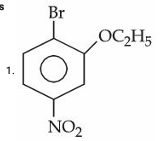
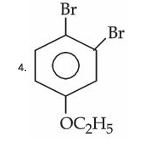
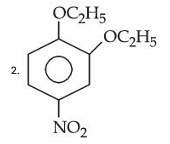
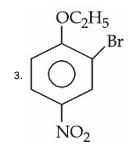
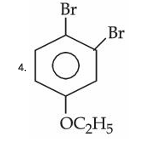
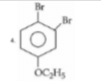
- A

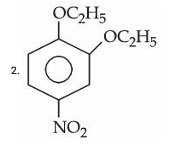
- B

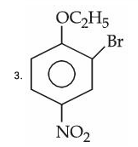
- C

- D


Correct answer:A
Standard Method
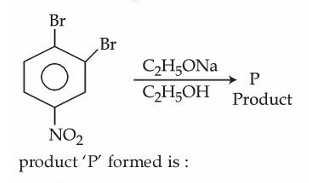
Given: A dibromonitrobenzene reacts with sodium ethoxide in ethanol. Find: the correct product P formed in this substitution reaction.
Identify the principle: This is a nucleophilic aromatic substitution reaction. The group is an electron-withdrawing group and activates the aromatic ring toward substitution at positions ortho and para to it.
Apply the idea: Ethoxide ion from sodium ethoxide acts as the nucleophile and replaces the bromine atom that is activated by the nitro group. The reaction proceeds through a Meisenheimer-type intermediate.
The solution states that one bromine atom is replaced by , giving 2-Bromo-4-nitrophenetole.
Therefore, the correct option is A.
Detailed Explanation
Given: The substrate is 1,2-dibromo-4-nitrobenzene and the reagent is sodium ethoxide in ethanol.
Find: Which product is formed.
Step 1: Understand the reaction type. This is not or at an aliphatic carbon. Since the substrate is an aromatic halide containing a strongly electron-withdrawing group, the relevant mechanism is nucleophilic aromatic substitution.
Step 2: Role of the nitro group. The group stabilizes the intermediate formed after nucleophilic attack. Therefore, a bromine atom activated by the nitro group can be displaced by the ethoxide nucleophile.
Step 3: Nucleophile involved. Sodium ethoxide provides , which attacks the activated aromatic carbon and ultimately replaces one bromine atom.
Step 4: Product identification. The extracted solution explicitly concludes that the product formed is 2-Bromo-4-nitrophenetole and also marks Option A as correct.
Therefore, the correct option is A.
Choosing a product with two ethoxy substitutions is incorrect because the provided solution describes replacement of only one bromine atom under the given conditions. Keep track of the extent of substitution shown in the solution.
Treating the reaction as ordinary or on an aromatic carbon is wrong because aryl halides do not undergo these mechanisms easily. Use nucleophilic aromatic substitution when an electron-withdrawing group such as is present.
Ignoring the activating effect of the group leads to the wrong substitution position. The nitro group makes certain ring positions more susceptible to nucleophilic attack, so identify the bromine activated by before selecting the product.
Get unlimited AI-adaptive practice, mastery tracking, and an AI tutor that explains every step — free to start.