
Match List-I with List-II
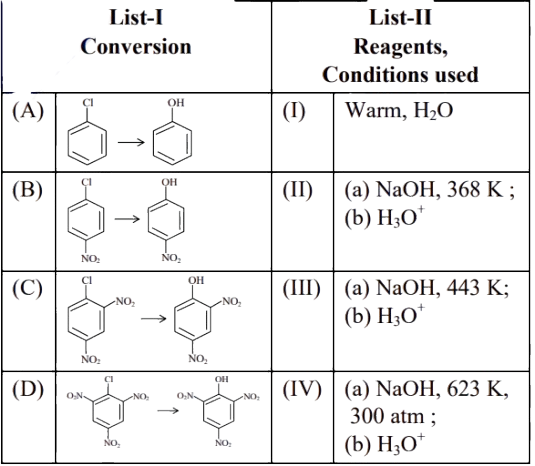
Choose the correct answer from the options given below :
- A
(A)-(II), (B)-(III), (C)-(I), (D)-(IV)
- B
(A)-(III), (B)-(IV), (C)-(II), (D)-(I)
- C
(A)-(IV), (B)-(III), (C)-(II), (D)-(I)
- D
(A)-(IV), (B)-(III), (C)-(I), (D)-(II)
Match List-I with List-II
Choose the correct answer from the options given below :
(A)-(II), (B)-(III), (C)-(I), (D)-(IV)
(A)-(III), (B)-(IV), (C)-(II), (D)-(I)
(A)-(IV), (B)-(III), (C)-(II), (D)-(I)
(A)-(IV), (B)-(III), (C)-(I), (D)-(II)
Correct answer:C
Standard Method
Given: A matching question on nucleophilic substitution in aryl halides.
Find: The correct correspondence between the conversions in List-I and the reagents/conditions in List-II.
The reactivity of aryl halides towards nucleophilic substitution increases significantly with the presence of electron-withdrawing groups, especially nitro groups, at ortho and para positions. The more the number of such groups, the milder the conditions required for the substitution reaction.
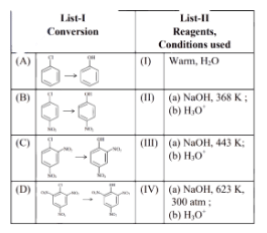
From the listed conversions:
Conversion (A) is chlorobenzene to phenol. Since chlorobenzene has no activating nitro group, it requires very harsh conditions: aqueous NaOH, , , followed by acidification. So (A) - (IV).
Conversion (B) is converted under conditions NaOH, followed by . So (B) - (III).
Conversion (C) proceeds with NaOH, followed by . So (C) - (II).
Conversion (D) occurs under the mildest condition, warm water, so (D) - (I).
Thus, the correct matching is:
Therefore, the correct option is C.
Reactivity Order Based Matching
Given: Four aryl chloride derivatives are converted to corresponding phenols using different conditions.
Find: Match each substrate with the proper reagent set.
This is a nucleophilic aromatic substitution problem. As the number of nitro groups at ortho/para positions increases, the bond becomes more reactive towards replacement by .
So the required severity of conditions decreases in the order:
Hence the conditions match from harshest to mildest as follows:
Therefore:
This corresponds to option C.
Note: Another extracted approach in the source discusses a different intermediate matching pattern, but the solution heading explicitly states The Correct Option is C, and the listed final mapping above is the accepted answer on the page.
Students often ignore the activating effect of nitro groups on nucleophilic aromatic substitution. This is wrong because ortho and para nitro groups stabilize the intermediate and make substitution easier. Instead, compare the number and positions of electron-withdrawing groups before matching the conditions.
A common mistake is to assume all aryl chlorides react with aqueous NaOH under similar conditions. This is incorrect because chlorobenzene without activating groups needs very harsh Dow process conditions. Instead, assign the harshest condition to the least activated substrate.
Some students match warm water with a less reactive substrate. This is wrong because only the most strongly activated aryl halide undergoes hydrolysis under such mild conditions. Instead, reserve the mildest reagent for the substrate containing the maximum nitro activation.
Get unlimited AI-adaptive practice, mastery tracking, and an AI tutor that explains every step — free to start.