Two wires each of radius and negligible mass, one made of steel and the other made of brass, are loaded as shown in the figure. The elongation of the steel wire is:
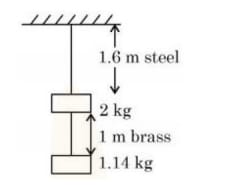
Two wires each of radius and negligible mass, one made of steel and the other made of brass, are loaded as shown in the figure. The elongation of the steel wire is:

Correct answer:20
Standard Method
Given: radius of each wire is . The upper wire is steel of length and the lower wire is brass of length . The attached masses are and .
Find: elongation of the steel wire.
From the loading shown, the tension in the steel wire is the total load supported above the lower section:
The elongation of the steel wire is given by:
where
Substituting these values:
Simplifying:
Therefore,
So, the elongation of the steel wire is .

Using tensile stress relation
Given: elongation is to be found for the steel part only.
Use the relation for elongation under tensile stress:
The steel segment supports both loads, so the force in it is as obtained in the working.
Its cross-sectional area is:
Now substitute in the formula:
This evaluates to:
Hence, the required numerical value is 20 when written as .
Using only the load for the steel wire tension is incorrect because the steel segment supports both attached loads. Use the total supported force shown in the solution working.
Not converting radius from to meters gives a wrong area by a large factor. Convert first: .
Using diameter instead of radius in is wrong. The question gives the radius directly, so substitute that value without doubling it.
Get unlimited AI-adaptive practice, mastery tracking, and an AI tutor that explains every step — free to start.