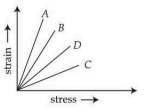
The strain-stress plot for materials A, B, C and D is shown in the figure. Which material has the largest Young's modulus?
- A
A
- B
C
- C
B
- D
D
The strain-stress plot for materials A, B, C and D is shown in the figure. Which material has the largest Young's modulus?

A
C
B
D
Correct answer:A
Standard Method
Given: A strain-stress plot for materials A, B, C and D is shown.
Find: Which material has the largest Young's modulus.
Young's modulus is
In a strain-stress graph, the slope is
So, the material with the smallest slope has the largest Young's modulus.
From the figure, line A is the flattest relative to the stress axis among the labeled materials according to the solution explanation, so it has the largest Young's modulus.
Therefore, the correct option is A.
Using the axis interpretation carefully
Given: The graph is strain on Y-axis and stress on X-axis.
Find: The material with maximum Young's modulus.
A common confusion is to treat this as a stress-strain graph. But here the axes are reversed.
For Young's modulus,
Hence on this graph,
This means:
The solution states that material A has the least steep slope relative to the stress axis, while D is steeper. Therefore A has the highest value of Young's modulus.
Thus, the correct option is A.
Mistake: Treating the graph as a stress-strain graph and choosing the steepest line. Why it is wrong: the given axes are reversed. What to do instead: first check which quantity is on each axis, then relate slope to the required physical quantity.
Mistake: Using . Why it is wrong: Young's modulus is defined as stress divided by strain. What to do instead: write and then invert the graph slope if the plot is strain versus stress.
Mistake: Assuming the visually steepest line always means the strongest or stiffest material. Why it is wrong: steepness depends on what is plotted on the axes. What to do instead: express the slope mathematically in terms of stress and strain before comparing materials.
Get unlimited AI-adaptive practice, mastery tracking, and an AI tutor that explains every step — free to start.