
The compound which will have the lowest rate towards nucleophilic aromatic substitution on treatment with is:
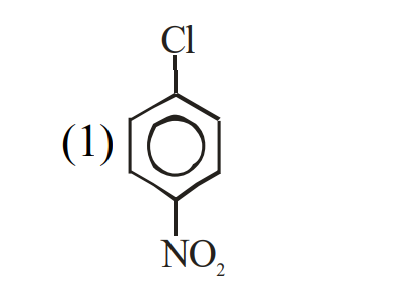
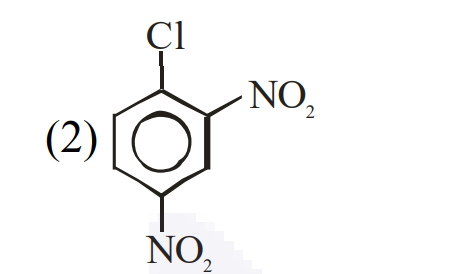
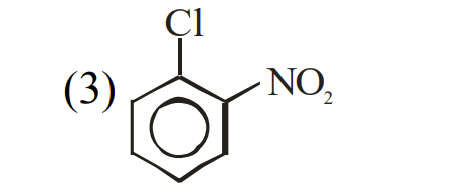
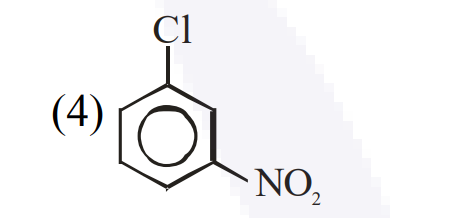
- A
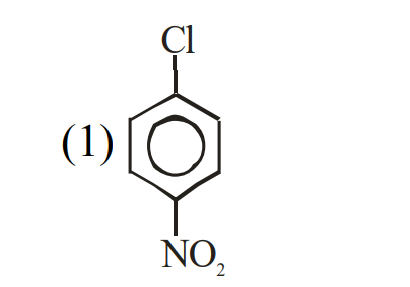
- B
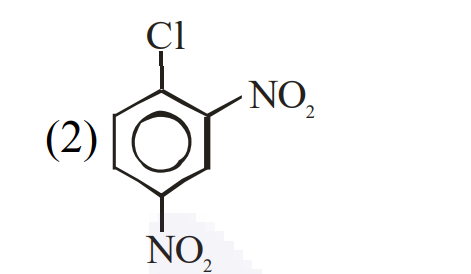
- C
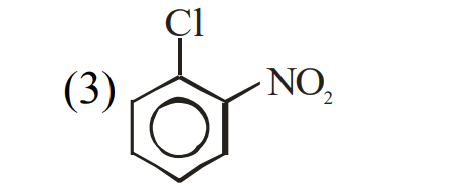
- D
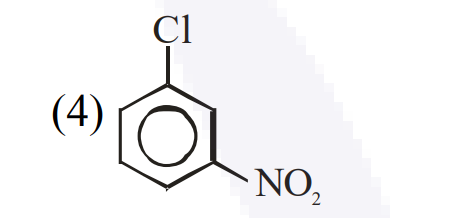
The compound which will have the lowest rate towards nucleophilic aromatic substitution on treatment with is:
Correct answer:D
Standard Method
Given: Four chloronitrobenzene derivatives are compared for nucleophilic aromatic substitution with .
Find: Which compound has the lowest rate.
For nucleophilic aromatic substitution, electron-withdrawing groups such as increase the rate strongly when they are present at the ortho or para position to the leaving group, because they stabilize the anionic Meisenheimer intermediate.
A nitro group at the meta position does not provide this resonance stabilization effectively.
Therefore:
Hence the compound shown in option (4) has the lowest rate towards nucleophilic aromatic substitution.
The correct option is D.
Assuming that any group increases the rate equally is incorrect. In nucleophilic aromatic substitution, position matters; only ortho and para nitro groups stabilize the Meisenheimer intermediate well. Always check the relative position with respect to the leaving group.
Judging the answer only by the number of groups can be misleading. A single meta nitro group may be less activating than a single ortho or para nitro group because it lacks effective resonance stabilization of the intermediate.
Confusing nucleophilic aromatic substitution with electrophilic aromatic substitution leads to wrong trends. Here the key factor is stabilization of the negatively charged intermediate, not the usual directing effects used in electrophilic substitution.
Get unlimited AI-adaptive practice, mastery tracking, and an AI tutor that explains every step — free to start.